
Chinese Revolution
 1
4.4
1
4.4

- noun
- /ˈtʃaɪniːz ˌrɛvəˈluːʃən/
- The Chinese described the Cuban revolution as being very close in character to the Chinese revolution—both armed struggles of the masses.
Loading YouTube…
Watch on YouTubeThey were people of high intellectual caliber who were supportive of the Chinese revolution.
- They were people of high intellectual caliber who were supportive of the Chinese revolution.
Examples
-
Were the elderly fathers of the Chinese Revolution subconsciously eradicating an unfilial generation of China's youth?
Academic text (1990) -
No, the various campaigns of mass murder were an essential part of the Russian, French, and Chinese revolutions.
Blog text (22) -
What a miracle for Americans still trembling from the Chinese Revolution.
Academic text (1995) -
Instead, they were rhapsodizing about the beauties of the Chinese revolution.
Blog text (18) -
The frightening thing about that condition is that whole societies can do it, as they did during the French, Russian, and Chinese Revolutions.
Blog text (1) -
Chinatown politics had enjoyed a period of popular front unity during the 1930s and 1940s, but that situation changed after the Chinese Revolution and the advent of the Cold War.
Academic text (1998) -
When Soviet Comintern agents organized the Communist Party in China, the Comintern's original directive was for the Chinese proletariat to lead the Chinese revolution.
Academic text (2003) -
As a Crown Colony, Hong Kong was also spared the potentially economically disruptive effects of democracy and the worst of the turmoils that were to become the Chinese Revolution.
Academic text (1990) -
U.S. support for state-led industrialization in Japan and Korea (in contrast to U.S. policy in Latin America) is only understandable as a geopolitical response to the Chinese revolution.
Academic text (2000) -
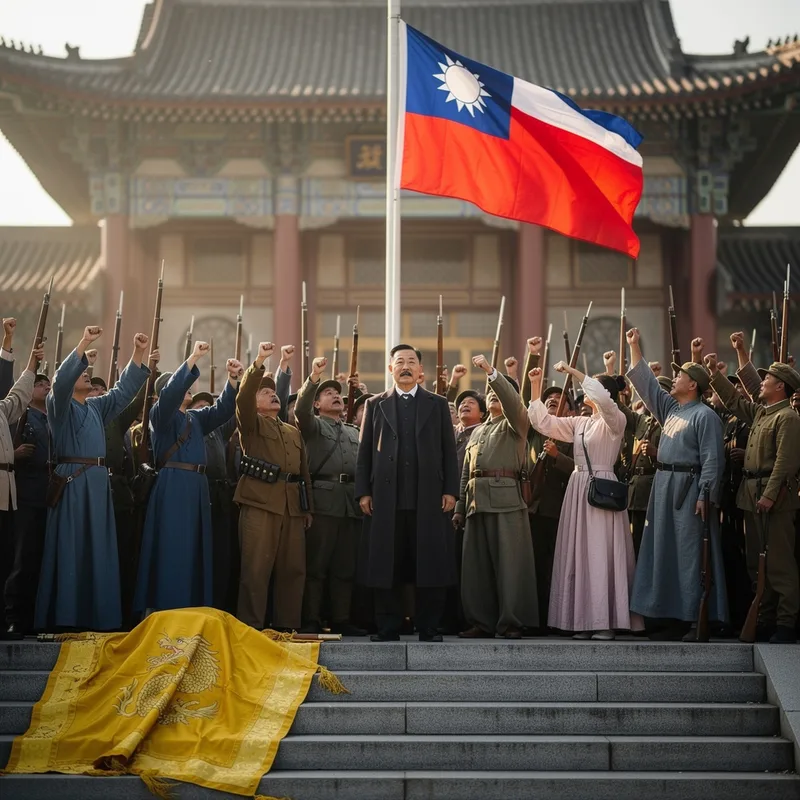
The Chinese Revolution overthrew the Manchu dynasty and established the Republic of China in 1912.
Surface Forms
Morphology
The meaning is directly compositional: 'Chinese' specifies the national/location attribute and 'revolution' denotes an overthrow or major political change, so a B1 learner who knows both words can infer 'a revolution in China.' This noun phrase pattern (national adjective + event noun) is cross-linguistically common and therefore immediately understandable to learners.
Etymology
Chinese Revolution refers to the 1911 event in China when many people and soldiers rose up to remove the ruling Qing family and start a republic. The word revolution shows the picture of turning the old system upside down, so Chinese Revolution means the historical change that 'ended' imperial rule and began the Republic of China.