
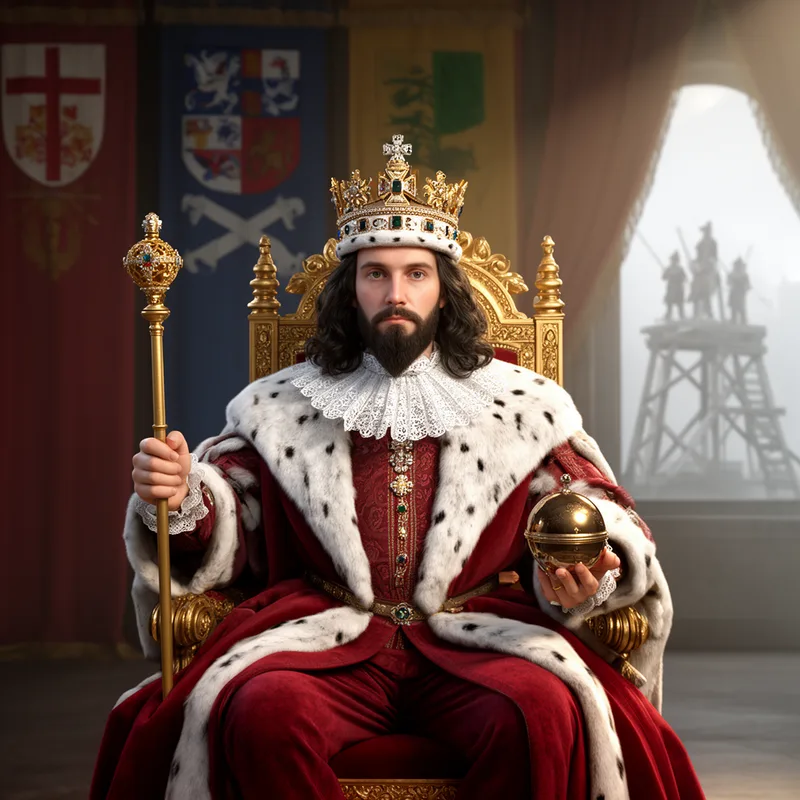
Charles I of England


 1
8.0
- proper noun
- Charles I of England ascended the throne in 1625 after the death of his father, James I.
Examples
-
The execution of Charles I of England marked a turning point in British history.
-
Many historians debate the legacy of Charles I of England and his role in the English Civil War.
-
Many historians study Charles I of England to understand the English Civil War.
-
Did Charles I of England believe in the divine right of kings?
-
Charles I of England became king in 1625, leading to significant changes in the monarchy.
-
The conflict between Parliament and Charles I of England intensified, sparking a civil war.
-
Ultimately, the reign of Charles I of England ended with his execution in 1649.
Synonyms
 1
7.2
King of England from 1625 to 1649 whose fight with Parliament led to civil war and his execution
 1
8.9
A king of England, Scotland, and Ireland removed and executed in 1649 during the civil war
Surface Forms
Morphology
Charles + I + of + England
The string is compositionally clear: a personal name 'Charles' + the regnal marker 'I' (the first) + 'of England' (association with the country), so a learner who knows the parts will infer 'Charles the First of England'. However, the specific status as the king and the historical details (dates, reign, execution) are not predictable from the words alone and require background knowledge, so the expression is only partially transparent.
Etymology
Charles I of England is the name for the first King called Charles who ruled England; the I shows he was the first Charles and of England shows the country he ruled. He became famous because he fought with Parliament, which led to the English Civil War and his execution, so his name now often reminds people of that turning point in British history.