
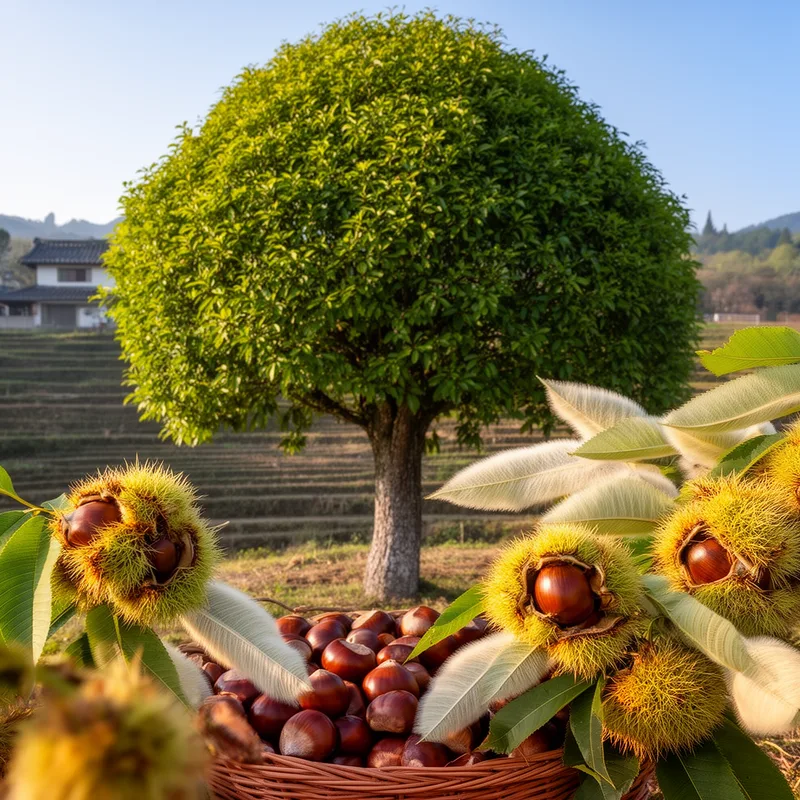
Castanea mollissima
- noun
- Specialized
- Farmers in China cultivate Castanea mollissima for its sweet, edible nuts.
Examples
-
Many chefs prefer using Castanea mollissima nuts in their recipes.
-
The Castanea mollissima is prized for its resistance to chestnut blight.
-
The leaves of Castanea mollissima are softly hairy underneath, making it easy to distinguish.
-
The Castanea mollissima tree thrives in warm climates.
-
Farmers in China cultivate Castanea mollissima for its sweet, edible nuts.
-
Many chefs prefer using Castanea mollissima nuts in their recipes.
-
The Castanea mollissima tree produces nuts that are a popular ingredient in desserts.
Synonyms

A tree from China and Korea that makes small sweet nuts you can eat
Surface Forms
Morphology
Castanea + mollissima
This is a Latin binomial — a technical taxonomic name — not a compositional English phrase. An average B1 learner who knows the (specialist) label 'Castanea' would not be able to derive the specific sense 'a species of chestnut tree producing edible sweet nuts' from the constituents, and 'mollissima' is not a common English word (no dictionary gloss), so the meaning is not predictably built from known English words. Therefore the term functions as an opaque, domain-specific proper name requiring prior exposure or specialist knowledge.
Etymology
Castanea mollissima comes from older Latin and Greek words: Castanea means 'chestnut' and mollissima means 'very soft'. People likely used mollissima because the tree has soft, fuzzy leaves and the nut is soft inside, so the name fits the sweet, edible chestnut we eat today.

