
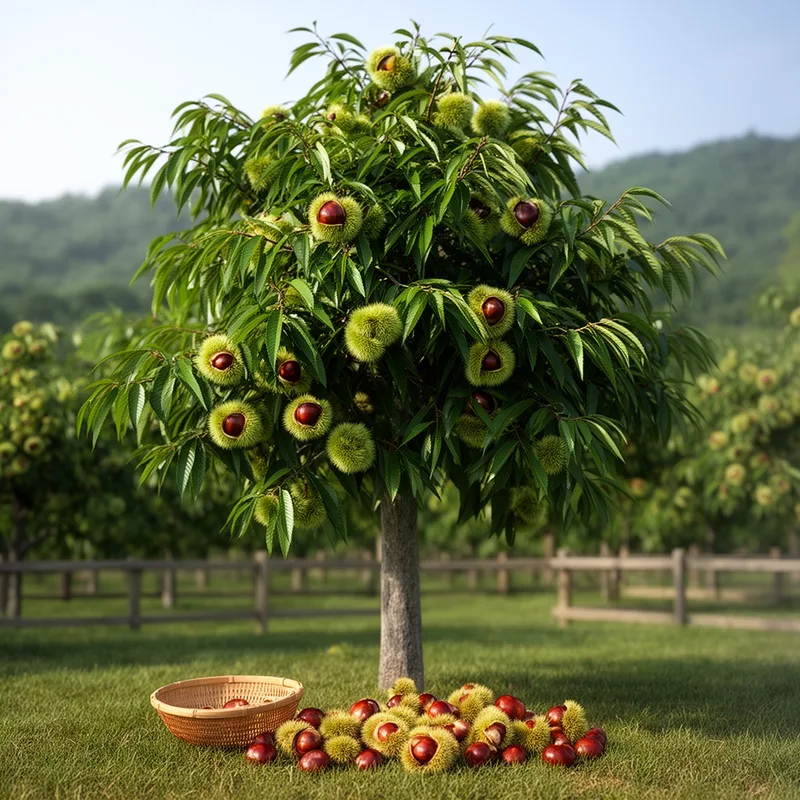
Castanea crenata
- noun
- Specialized
- The Castanea crenata is widely cultivated in Japan for its edible nuts.
Examples
-
Researchers studied the disease resistance of Castanea crenata compared to other chestnut species.
-
Gardeners often plant Castanea crenata for its attractive spreading canopy and useful timber.
-
The Castanea crenata is a beautiful tree.
-
Many gardeners appreciate the Castanea crenata for its ornamental value.
-
Gardeners often plant Castanea crenata for its attractive spreading canopy and useful timber.
-
Researchers studied the disease resistance of Castanea crenata compared to other chestnut species.
-
The Castanea crenata is widely cultivated in Japan for its edible nuts.
Synonyms
A tree from Japan that loses its leaves and produces edible nuts
Surface Forms
Morphology
Castanea + crenata
This is a Linnaean binomial (genus + species epithet), so a learner who knows 'Castanea' and the taxonomic pattern can infer it denotes a kind of chestnut tree (i.e., a species of Castanea). However, the species epithet 'crenata' is Latin and does not transparently signal the specific traits or the geographic label 'Japanese chestnut' to a B1 learner, so the full specific meaning is not fully predictable.
Etymology
Castanea crenata gets its name from old words for the tree and the shape of its leaves. Castanea is the old word for 'chestnut' and crenata means 'notched', like the small teeth on a leaf, so the name describes a chestnut tree with notched leaves that grows in Japan and Korea.

