
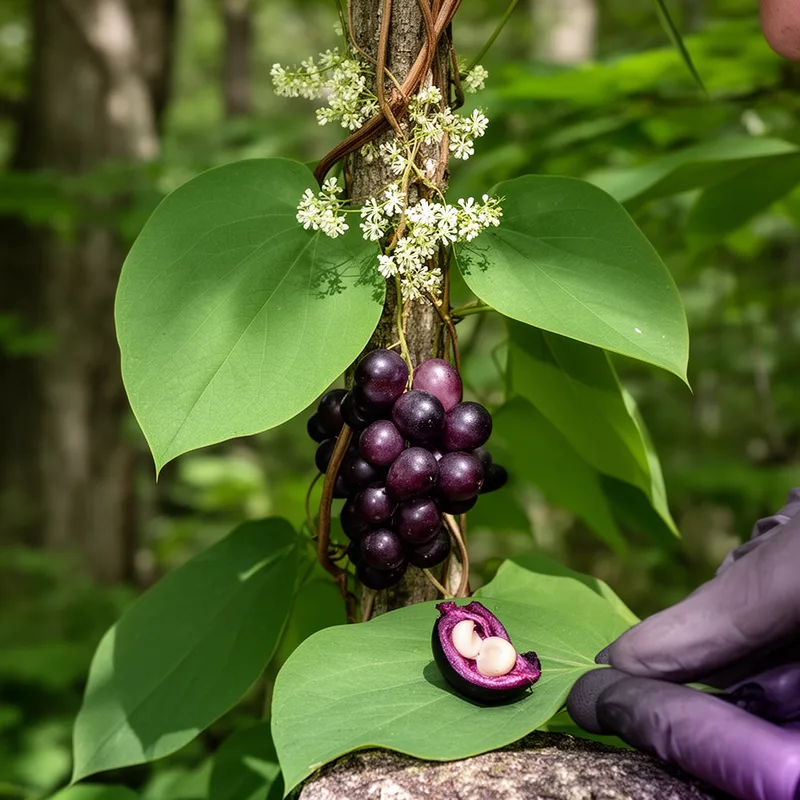
Canada moonseed
- noun
- US
- You can recognize Canada moonseed by its large oval leaves and clusters of small white flowers.
Examples
-
The fruit of the Canada moonseed is easily mistaken for wild grapes but is poisonous.
-
I spotted a Canada moonseed vine climbing the tree.
-
Botanists studied how Canada moonseed climbed through the forest understory.
-
You can recognize Canada moonseed by its distinctive moon-shaped seeds.
-
The Canada moonseed is often found in wooded areas.
-
The vine of the Canada moonseed weaved around the trees in the dense forest.
-
In late summer, the Canada moonseed produces small purple to blue-black fruits that are toxic to humans.
Synonyms

A climbing vine from eastern North America with large leaves and grape-like poisonous berries

A woody climbing plant from eastern North America with large oval leaves and dark blue or purple berries

A climbing woody plant with large oval leaves, white flowers, and dark berries

A vine with red or black berries that have moon-shaped seeds and are poisonous
Surface Forms
Morphology
This is a straightforward place-name + noun compound: a learner who knows 'Canada' and 'moonseed' will naturally infer it denotes the moonseed species associated with Canada (i.e., a moonseed found in or native to that region). Geographic modifiers forming species or variety names are cross-linguistically common and follow regular compositional patterns, so the overall meaning is transparently derivable even if precise botanical details require specialist knowledge.
Etymology
Canada moonseed gets its name from the plant's small moon-shaped seeds and from the fact that it grows in Canada and nearby parts of eastern North America. That's why the name fits a woody vine whose fruit can look like grapes but whose seeds are tiny moons and whose berries are 'poisonous'.

