
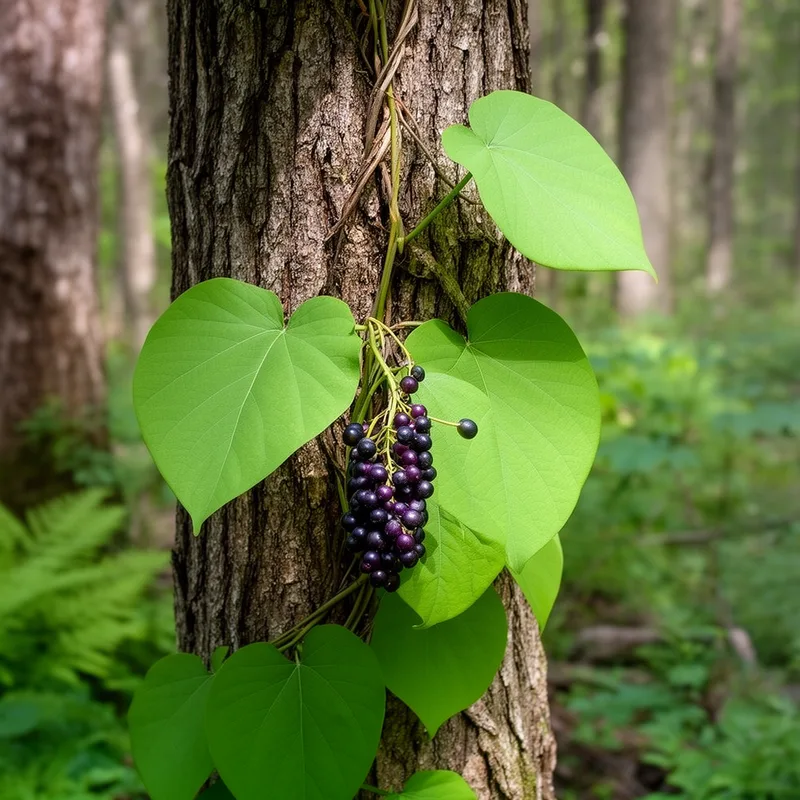
Menispermum canadense
- noun
- Specialized
- Botanists often study Menispermum canadense for its unique leaf shape and climbing habit.
Examples
-
The berries of Menispermum canadense resemble grapes but are highly toxic if ingested.
-
Hikers should be cautious when handling Menispermum canadense in the wild due to its poisonous fruit.
-
Look at that Menispermum canadense!
-
The Menispermum canadense is often found in wooded areas.
-
The bright purple berries of Menispermum canadense can be dangerous if eaten.
-
Many people enjoy hiking in areas where Menispermum canadense grows due to its beautiful leaves.
-
The vine of Menispermum canadense is a common sight on trails in eastern North America.
Synonyms

A woody vine with large oval leaves, small white flowers, and purple fruit that is poisonous

A woody climbing plant from eastern North America with large oval leaves and dark blue or purple berries

A climbing woody plant with large oval leaves, white flowers, and dark berries
Surface Forms
Morphology
Menispermum + canadense
This is a standard binomial name composed of the genus 'Menispermum' (a moonseed/climbing plant) plus the species epithet 'canadense' (of or from Canada), so the meaning ('the Menispermum species from Canada' / 'Canadian moonseed') is directly derivable from the parts. Binomial nomenclature routinely uses such geographic or descriptive epithets, a predictable compositional pattern that a learner who knows both constituents can infer.
Etymology
Menispermum canadense gets its name from its curved seed: Menispermum comes from old words meaning 'moon' and 'seed', and canadense means 'from Canada'. That's why people call it the 'Canadian moonseed', a simple picture to remember its moon-shaped seed and its grape-like but poisonous fruit.

