

Caesalpinia sepiaria
- noun
- Specialized
- Gardeners appreciate Caesalpinia sepiaria for its vibrant yellow flowers and ornamental value.
Examples
-
The dense growth of Caesalpinia sepiaria provides excellent shelter for birds.
-
In some regions, Caesalpinia sepiaria is planted as a hedge to repel livestock.
-
The Caesalpinia sepiaria thrives in tropical climates.
-
I saw a beautiful Caesalpinia sepiaria in the garden.
-
Gardeners appreciate Caesalpinia sepiaria for its vibrant yellow flowers and ornamental value.
-
In some regions, Caesalpinia sepiaria is planted as a hedge to repel livestock.
-
The dense growth of Caesalpinia sepiaria provides excellent shelter for birds.
Synonyms
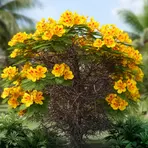
A thorny spreading shrub from tropical Asia with large yellow flowers with red marks

A spreading thorny shrub with tall groups of yellow flowers marked with red
Surface Forms
Morphology
Caesalpinia + sepiaria
This is a botanical Latin binomial where the second element 'sepiaria' is not an English lexical item and functions as a species epithet rather than a descriptive English word. Even if a learner knows 'Caesalpinia' as a genus of tropical trees, the full specific meaning (a spreading thorny shrub with yellow flowers) cannot be derived compositionally from the parts, so the name acts as a label and is not transparently interpretable.
Etymology
Caesalpinia sepiaria is named in two parts: Caesalpinia honors Andrea Cesalpino, an Italian doctor who studied plants, and sepiaria comes from a Latin word for 'hedge' because the thorny shrub was often used as a living fence. That's why the name helps you remember it is a spreading, thorny shrub used as a hedge with bright yellow flowers.

