

Mysore thorn
- noun
- Indian
- Gardeners admire the Mysore thorn for its striking clusters of yellow flowers with a red mark.
Examples
-
The Mysore thorn is often planted as a hedge because of its dense, spiny branches.
-
In some regions, the Mysore thorn is considered an invasive species due to its rapid spread.
-
The Mysore thorn is a beautiful shrub.
-
Many gardeners love the Mysore thorn for its vibrant colors.
-
Gardeners admire the Mysore thorn for its striking clusters of yellow flowers with a red mark.
-
In some regions, the Mysore thorn is considered an invasive species due to its rapid spread.
-
The Mysore thorn is often planted as a hedge because of its dense, spiny branches.
Synonyms

A spreading thorny shrub from tropical Asia with upright groups of yellow flowers with red spots
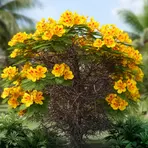
A thorny spreading shrub from tropical Asia with large yellow flowers with red marks
Surface Forms
Morphology
The compound is fully compositional: 'Mysore' names a place/region and 'thorn' denotes a sharp-pointed plant part or thorny plant, so a learner who knows both words can infer it refers to a thorny plant associated with Mysore. This place-name + noun pattern is cross-linguistically common and follows ordinary English compound formation, making the meaning immediately understandable even if the learner lacks botanical detail.
Etymology
Mysore thorn comes from the Indian region Mysore and the word thorn, because the shrub grows there and has many sharp spines. So the name simply points to a 'spreading thorny shrub' from that area, and that's why it means this thorny plant today.

