

CD8 T cell
- noun
- /siː diː eɪt tɪ ˈsɛl/
- Specialized
- In studies, researchers found that CD8 T cells were effective in eliminating cancer cells in the laboratory.
- antiviral CD8 T cells
- CD8 T cell response
- CD8 T cell function
Examples
-
CD8 T Cells: Activating, Sustaining, and Wearing Down the Effectors
Academic text (2017) -
After the vaccine, the body produced a robust response from the CD8 T cells, enhancing protection against the virus.
-
However, direct survival effects of IFN-I have also been reported on intratumoral CD8 T cells.
Academic text (2017) -
Due to their direct lysis of infected and cancer cells, the majority of effort to understand immune exhaustion has focused on CD8 T cells.
Academic text (2017) -
In addition, early IFN-I signaling drives the acquisition of CD8 T cell cytolytic function 61, 62, 65.
Academic text (2017) -
Interestingly, the effect of IFN-Is was not directly on the B cells themselves, but rather IFN-Is directly stimulated CD8 T cells to kill LCMV-specific B cells 65.
Academic text (2017) -
The decrease in immune activation was accompanied by increased anti-HIV CD8 T cell responses and a reduction in HIV titers and infected cells 132.
Academic text (2017) -
Granulomatous lesions contain abundant macrophages and, as might be expected for cross-sectional studies, variable numbers of CD4 and CD8 T cells.
Academic text (1991) -
In cancer, IFN-Is have also been shown to enhance antitumor CD8 T cell effector function ex vivo by increasing their killing ability, which presumably accounted for the better tumor control upon adoptive transfer.
Academic text (2017) -
CD8 T cells are crucial for the immune system, as they recognize and kill virus-infected cells.
Synonyms

 1
4.3
1
4.3

A white blood cell that finds and kills virus-infected cells
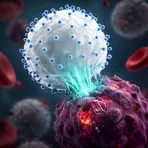
A white blood cell with a CD8 marker that kills infected or cancer cells

A type of white blood cell that finds and kills virus-infected or abnormal cells

A white blood cell that finds and destroys virus-infected or cancerous body cells
Surface Forms
Morphology
The form 'CD8 T cell' is compositionally built from the constituents (CD8 + T + cell) so a learner who knows that CD8 is a membrane protein and that a T cell is an immune cell can infer this denotes a subtype of T cell marked by CD8 and related to immune response. However, the specific functional details (e.g., recognising and killing virus-infected cells) are technical biological knowledge not directly derivable from the labels alone, so full meaning is not immediately predictable to a B1 learner.
Etymology
CD8 T cell: The name CD8 T cell comes from the small protein CD8 on the cell's surface that acts like a 'key' to spot infected cells. The term T cell shows it is a type of immune cell that hunts and kills invaders, so the name tells us this cell finds and destroys virus-infected cells.