
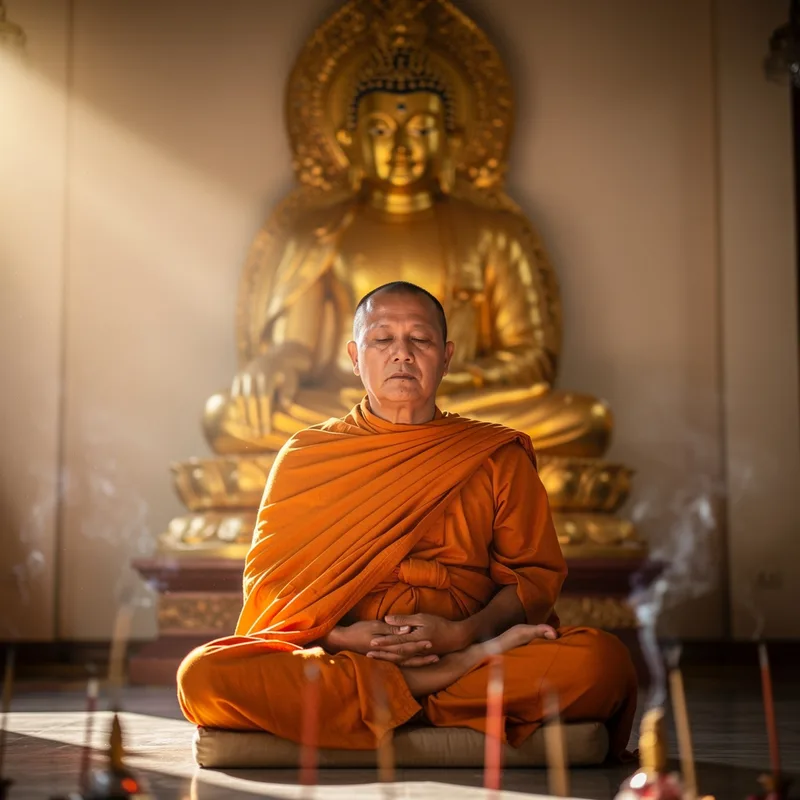
Buddhism
 60
2.9
60
2.9

- noun
- /ˈbʊdɪzəm/
- As was described above, Zen Buddhism played an important role in this rapprochement.
- practice of Buddhism
- Buddhism as a religion
- tradition in Buddhism
Loading YouTube…
Watch on YouTubeHe meditated, he studied Buddhism, he wrote poetry.
- He meditated, he studied Buddhism, he wrote poetry.
- I was studying Burmese Buddhism and Zen Buddhism and Tibetan Buddhism.
- And meditation was taught in Buddhism after ethics.
- And you mentioned Buddhism and Stoicism earlier.
- What's different though is Buddhism and Hinduism don't seem to have that effect.
- It's not going to be compatible with theistic versions of Buddhism, like Pure Land Buddhism.
- And he was studying Buddhism at the time.
- What's the difference between Buddhism and, you know, Hari Krishna or Hinduism?
- Now how should this be understood from the perspective of Buddhism?
- Buddhists don't perfectly keep the eightfold path of Buddhism.
- Let's discuss the eightfold path in Buddhism.
- He comes from a Catholic background and then switched over to Buddhism.
Examples
-
Many people in the world follow Buddhism as their main spiritual practice.
-
In my Religious Studies class, we actually had this chapter all about Buddhism and rebirth, and they talk about six realms.
-
But I think the city is like the capital of Buddhism in Russia.
-
The central message of Buddhism is not every man for himself.
-
You can study Buddhism and become a monk.
-
So, Mr. Wise One, tell me, when did you convert to Buddhism?
-
In college, I did meditation and practiced Buddhism.
-
Greek Buddhist monks would play a large role in the spread of Buddhism into China and beyond.
-
South Asia has given us Hinduism and Buddhism, in addition to a number of smaller religions.
Academic text (1999) -
She decided to learn more about Buddhism to understand its teachings better.
Compounds
 1
4.7
1
4.7
A form of Buddhism from Tibet that mixes Indian teachings with Tibetan religion


 1
4.0
1
4.0
A type of Buddhism that teaches meditation and direct insight to reach enlightenment

A branch of Buddhism that teaches everyone can become enlightened by compassion and helping others

- Slur
An old insulting term for early schools of Buddhism, especially Theravada, now seen as disrespectful

A branch of Buddhism that focuses on personal effort and the earliest Pali teachings
Surface Forms
Morphology
Etymology
Buddhism comes from Buddha, a title that means 'awakened' or 'enlightened' in old Indian languages, plus the ending -ism, which marks a 'belief' or 'system'. So, Buddhism is the teaching and way of life about becoming 'awake' to the true nature of life and reaching enlightenment.