
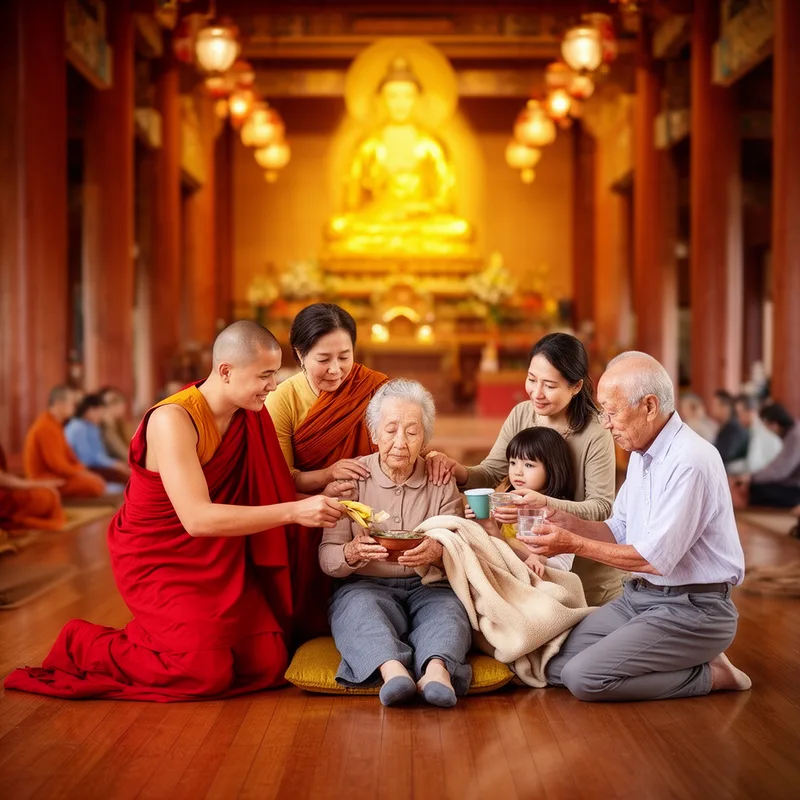
Mahayana Buddhism
- noun
- /məˈhɑːjənə ˈbʊdɪzəm/
- Zen developed around the seventh century C.E. from Mahayana Buddhism.
Examples
-
Mahayana Buddhism can be seen as an effort to expand the possibility of enlightenment to the masses.
Blog text (7) -
Within Mahayana Buddhism, new practices that led to Buddhist enlightenment were developed.
Academic text (2015) -
And I note that he is particularly comparing Tibetan Buddhism here with other forms of Mahayana Buddhism, but I think it's fair to toss in Theravada:
Blog text (8) -
The empire's official religions were Hinduism and Mahayana Buddhism until Theravada Buddhism was introduced from Sri Lanka.
Blog text (3) -
All religious traditions, too, posit the hierarchical nature of reality, as in the orders of angels described by Dionysius, or intermediate worlds in the cosmologies of Mahayana Buddhism.
Academic text (1994) -
Mahayana Buddhism emphasizes compassion and aims to help all beings achieve enlightenment.
-
In Mahayana Buddhism, practitioners believe that Buddha nature exists within every individual.
-
Many people find solace in the teachings of Mahayana Buddhism, which promote universal love and wisdom.
Synonyms
A major school of Buddhism that teaches kindness and help for all people, widely followed in East Asia
A form of Buddhism that teaches staying in life to help others become enlightened
Surface Forms
Morphology
The phrase is fully compositional: 'Mahayana' names a particular school (focused on universal salvation and compassion) and 'Buddhism' names the religion, so the combined noun simply denotes that branch of Buddhism. This modifier+head pattern is a transparent, cross-linguistic way to form subtypes, so a B1 learner who knows both constituents will readily infer the meaning.
Etymology
Mahayana Buddhism gets its name from two words, maha and yana, which mean 'great' and 'vehicle', and the picture is of a big vehicle carrying many people to enlightenment. Because of this 'big vehicle' image, Mahayana teaches helping all beings and offers a path to awakening for everyone, not just monks.

