
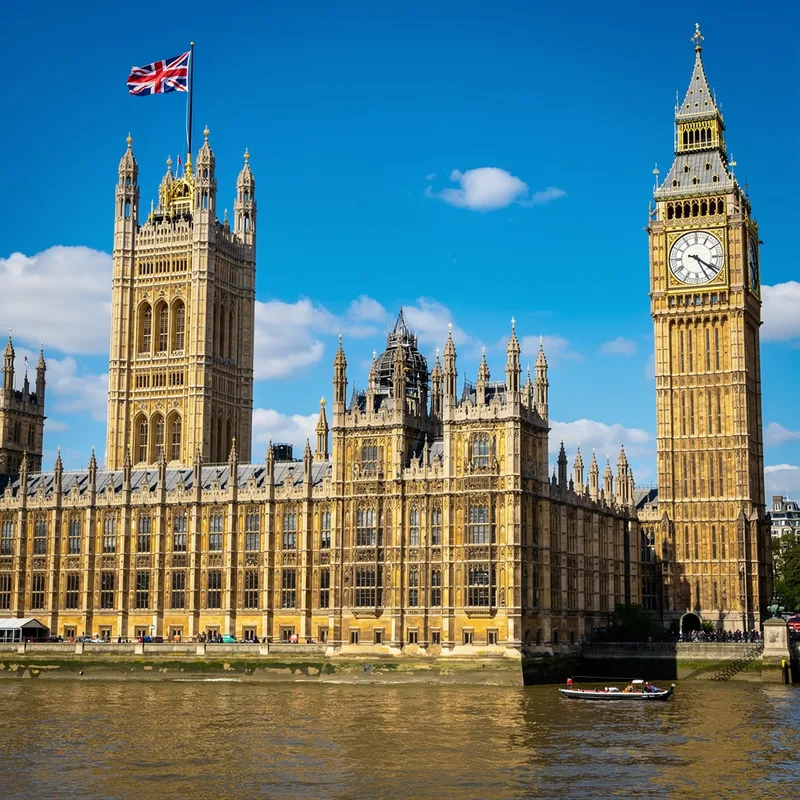
British Parliament
 8
3.5
8
3.5

- noun
- The British Parliament is responsible for making laws in the United Kingdom.
- The British Parliament passed an act
- act of the British Parliament
- member of the British Parliament
Loading YouTube…
Watch on YouTubeSo to summarize, yes, the Scottish Home Rule Bill almost made it through the British Parliament, but it was suspended by the outbreak of the First World War.
- So to summarize, yes, the Scottish Home Rule Bill almost made it through the British Parliament, but it was suspended by the outbreak of the First World War.
Examples
-
The British Parliament taxed the colonies without any direct colonial representation in Parliament.
Academic text (1991) -
The Englishman John Wilkes struggled to regain his seat in the British Parliament against the political manipulations of King George III and his ministers.
Academic text (1991) -
We have no representatives in the British Parliament.
Fiction book (2000) -
The implementation of this policy requires legislative action by the British Parliament.
Academic text (1990) -
In May 1773, the British Parliament passed the Tea Act to help the British East India Company get out of debt.
Fiction book (2000) -
That was written by Edmund Burke, a member of the British Parliament.
-
Americans protest that they have no representation in the British Parliament and can accept no taxation without representation.
-
So to summarize, yes, the Scottish Home Rule Bill almost made it through the British Parliament, but it was suspended by the outbreak of the First World War.
-
Both Canada and Australia gained independence peacefully through acts passed by the British Parliament; hence, neither had a searing revolutionary experience to forge an independent identity.
Academic text (1998) -
People like William Wilberforce build a coalition in the British Parliament of so-called dissenting Whigs, the dissenters.
Synonyms
 449
3.5
449
3.5
The group of people who make and pass a country's laws
 356
5.3
356
5.3
A group of people who make and change the laws of a country or region
 8
4.5
8
4.5
An official group of people who make and change laws for a country or state


 1
5.4
1
5.4
A group of elected people who make and change laws for a country or region
An old spelling for a national group that makes laws and decisions
Surface Forms
Morphology
The meaning is directly and transparently derived from 'British' (relating to Britain) + 'parliament' (the body that makes national laws), so a learner who knows both words will understand this denotes Britain’s national legislative body. This compositional pattern is cross-linguistically common and follows normal noun modification, making it immediately comprehensible to B1 learners even if they lack detailed knowledge of its internal structure.
Etymology
British Parliament comes from a word that once meant 'to speak', so imagine a group of people sitting together, talking and deciding rules for the country. That's why British Parliament means the country's main place where members meet to make laws.