
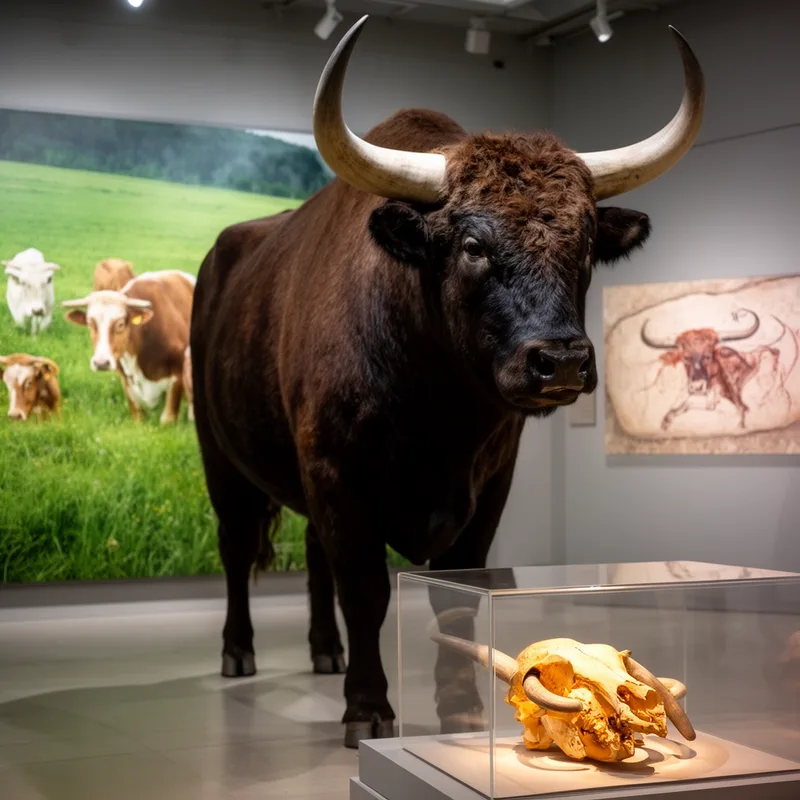
Bos primigenius
- noun
- Specialized
- Ancient cave paintings often depict the powerful horns of the Bos primigenius.
Examples
-
Fossil remains of the Bos primigenius have been found throughout Europe and Asia.
-
The Bos primigenius was a fascinating creature.
-
The Bos primigenius played a significant role in the domestication of modern cattle.
-
Did you know that Bos primigenius is the ancestor of modern cattle?
-
The Bos primigenius, known as the aurochs, once roamed the European landscape before its extinction in the 17th century.
-
Scientists study the DNA of Bos primigenius to understand the evolution of today's domestic cattle.
-
Fossils of Bos primigenius provide valuable insights into the ecosystems of prehistoric Europe.
Synonyms


 1
9.9
1
9.9
A very large wild ox from Europe that is now extinct and an ancestor of cows
A very large wild animal like an ox that lived long ago and later became farm cows

A very large wild ox that lived in Europe long ago
Surface Forms
Morphology
Bos + primigenius
The name is compositional: 'Bos' is the taxonomic genus for cattle and 'primigenius' (from Latin primigenius, ‘original/first-born’) signals something original or ancestral, so a learner who knows both parts could infer ‘original/ancestral cattle’ (i.e. the wild ancestor of domestic cattle). However, this is a Latin binomial and a specialized scientific label rather than a regular English phrase, so understanding requires familiarity with taxonomic naming and Latin roots rather than ordinary compositional rules.
Etymology
Bos primigenius comes from Latin words: Bos meaning 'ox' and primigenius meaning 'first' or 'original', so the name paints a picture of the 'first' ox. That's why it refers to the large wild ox that is now extinct and was an ancestor of today's cows.