
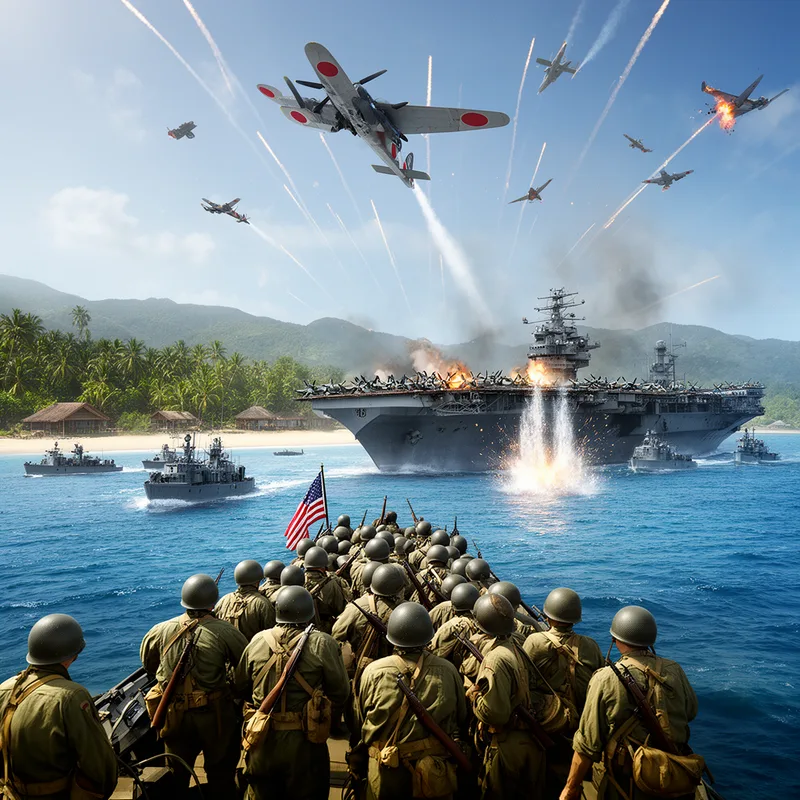
Battle of Leyte
- noun
- /ˈbætəl əv ˈleɪti/
- The outcome of the Battle of Leyte greatly influenced the course of World War II in the Pacific.
- Battle of Leyte Gulf
Examples
-
Three days later, the Battle of Leyte Gulf began, and after four days of fighting, it had become the greatest battle in the history of naval warfare.
Fiction book (1990) -
The Battle of Leyte in October 1944 was significant for marking the return of U.S. forces to the Philippines.
-
During the Battle of Leyte, Japanese forces launched their first kamikaze attacks against American ships.
Synonyms

A 1944 battle at Leyte that began the retaking of the Philippines and first used kamikaze attacks
Allied landing on Leyte Island, Philippines, in October 1944 that began the islands' liberation and saw Japan's first kamikaze attacks
Surface Forms
Morphology
The phrase combines the noun 'battle' with the prepositional 'of' plus a place name, so a B1 learner who knows the constituents can infer it refers to a battle that took place at Leyte. While detailed historical facts (dates, participants, kamikaze use) are not derivable from the words, the core locational/compositional meaning is directly transparent.
Etymology
Battle of Leyte comes from a big fight on the island of Leyte in 1944. It is remembered because United States troops returned to the Philippines there and because Japanese planes first used kamikaze attacks, so the name now refers to that major World War II battle.

