
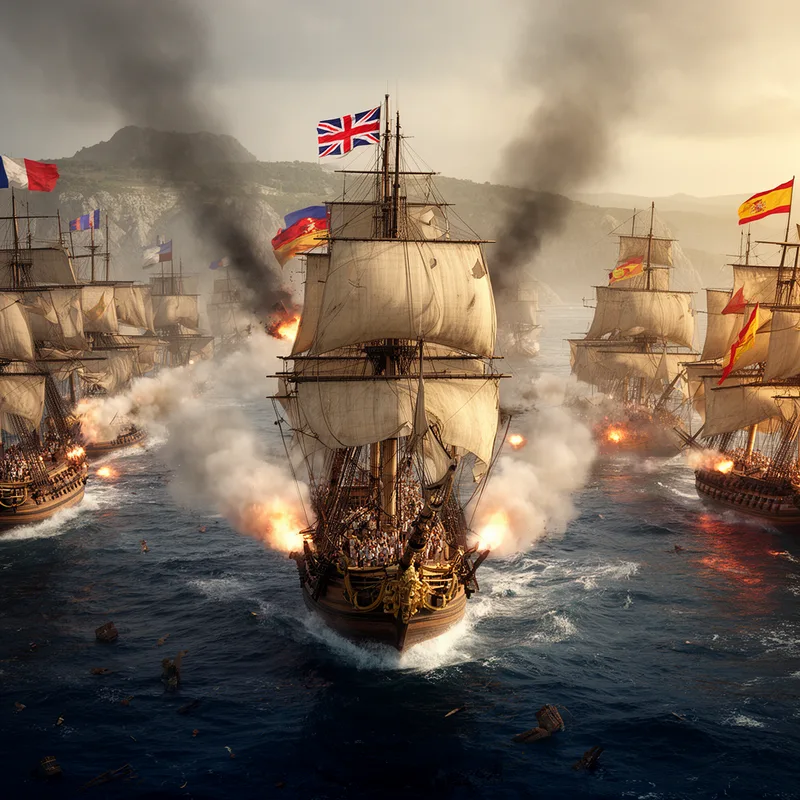
Battle of Trafalgar
 1
6.9
1
6.9

- proper noun
- During the Battle of Trafalgar in 1805, Admiral Nelson led the British fleet to a decisive victory against the French and Spanish navies.
- the Battle of Trafalgar in 1805
- Lord Nelson in the Battle of Trafalgar
Examples
-
Early in his career, in 1806, Turner painted a conventionally heroic scene of the conflict: The Battle of Trafalgar.
Academic text (1995) -
Most of us will have no trouble with the first three -- Admiral Horatio Nelson dying at the Battle of Trafalgar, the great German statesman, and the author of Tom Jones.
Academic text (1995) -
In 1814, Wentworth—who fought in the Battle of Trafalgar—could reappear because France had been defeated (or so it seemed).
Academic text (2007) -
Yet in retrospect at least, he recognizes the analogy to sacrifices no less fervently honored in his own civilized, Christian land: "Soon after the battle of Trafalgar, I heard a young lady exclaim, 'I could really wish to have had a brother killed in that action.'"
Academic text (1991) -
The Battle of Trafalgar marked a turning point in naval warfare, solidifying British naval dominance for decades to come.
-
Historians frequently study the strategies employed during the Battle of Trafalgar to understand the evolution of naval tactics.
Synonyms
 7
7.7
7
7.7
A place off the southwest coast of Spain where the British navy beat the French and Spanish ships in 1805
How Decisive

Surface Forms
Morphology
The phrase is compositionally built from 'battle' + 'of' + the place name 'Trafalgar', so a learner who knows those constituents will understand it denotes a battle that took place at Trafalgar. This place‑of construction (Battle of X) is cross‑linguistically common for naming historical battles, so the basic referential meaning is immediately derivable even if specific historical details (date, combatants) are not.
Etymology
The Battle of Trafalgar is named after Cape Trafalgar, a rocky point on the coast of Spain where, in 1805, British ships met the French and Spanish fleets. Admiral Nelson's ships broke the enemy line and won a great 'sea victory', so the name now refers to that famous win at sea.