
Battle of Fredericksburg


 1
7.9
- noun
- /ˈbætəl əv ˈfrɛdərɪksbɜrg/
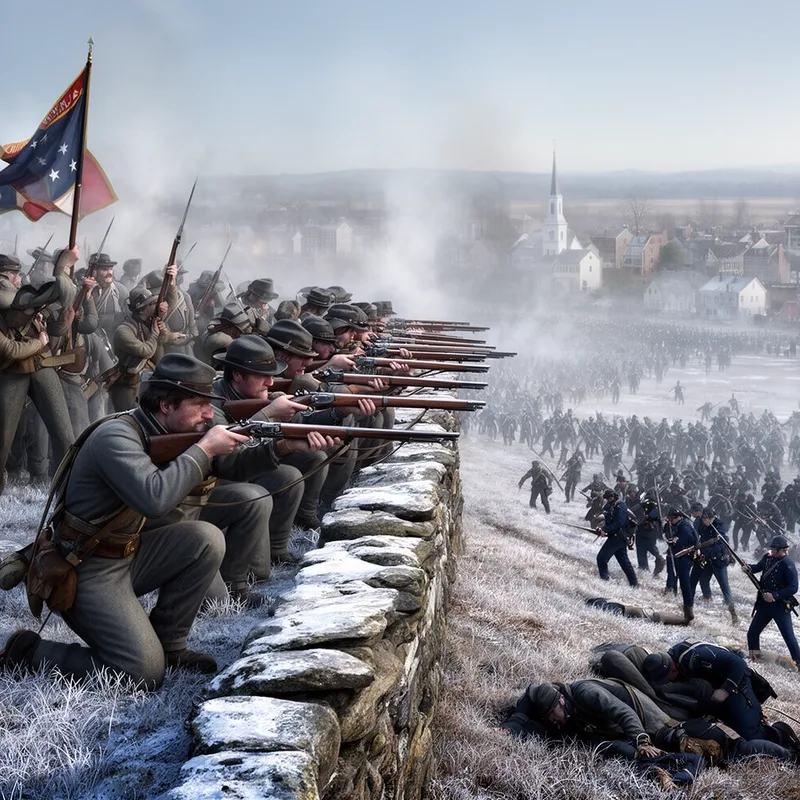
- Union soldiers faced heavy losses during the Battle of Fredericksburg, which took place in December 1862.
Examples
-
Many soldiers lost their lives during the Battle of Fredericksburg in 1862.
-
The Union's defeat at the Battle of Fredericksburg had a significant impact on morale.
-
Historians often analyze the Battle of Fredericksburg to understand military tactics of the Civil War era.
-
The Battle of Fredericksburg was a significant conflict in the Civil War.
-
What happened during the Battle of Fredericksburg?
-
The Battle of Fredericksburg was a significant event in the American Civil War that showcased the strength of Confederate forces.
-
Historians often analyze the strategies used in the Battle of Fredericksburg to understand the dynamics of Civil War tactics.
Surface Forms
Morphology
battle + of + Fredericksburg
The phrase is compositionally built from 'battle' + 'of' + the place name 'Fredericksburg', so a learner who knows those words will understand it denotes a battle that took place at Fredericksburg. While they would not infer historical specifics (dates, commanders, or outcome) from the constituents, the basic referential meaning is directly derivable and follows a common cross-linguistic naming pattern for battles.
Etymology
Battle of Fredericksburg is named for the town of Fredericksburg, Virginia, where Union and Confederate armies fought in December 1862. Union soldiers crossed the river and attacked uphill into the town but were badly defeated, so the name now brings to mind that large, bloody 'defeat' in the American 'Civil War'.