
Baroque era


 1
8.1
1
8.1
- noun
- /bəˈroʊk ˈɛrə/
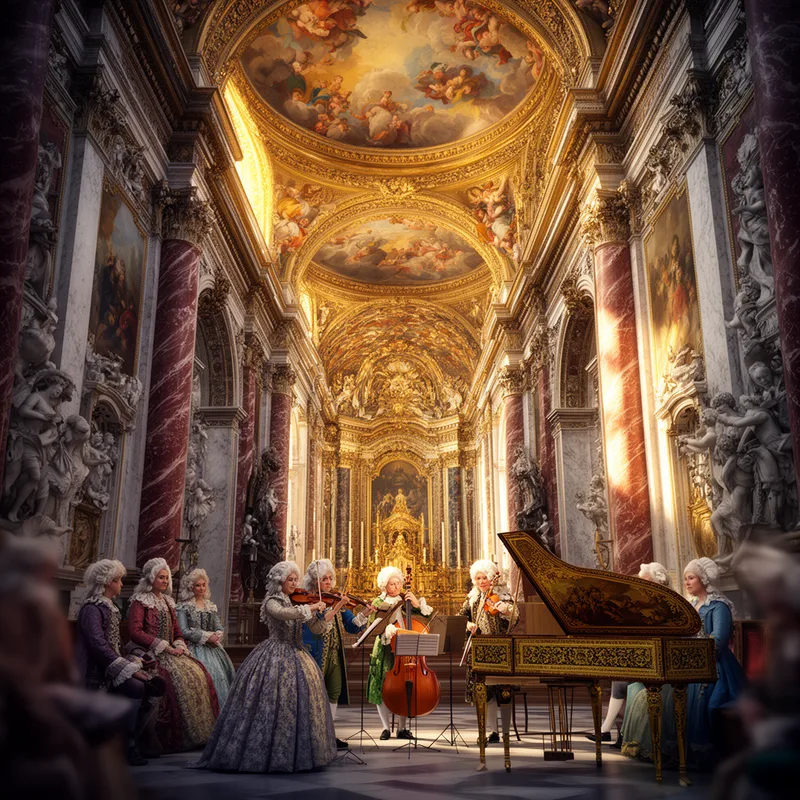
- The elaborate decorations found in churches from the baroque era reflect the artistic trends of the time.
Examples
-
For an analysis of the changes in the myth obtaining during the Baroque era, see Joseph E. Gillet, "Lucrecia-Necia."
Academic text (1994) -
On the other hand, the literature of art criticism from the Baroque era forward is rich in demonstrations of the beholder's share in any aesthetic transaction.
Academic text (1998) -
One performance could be based on the compositions and music of the Baroque era, whereas the next quarter's instruction might focus on developing students' skill and knowledge in bluegrass music.
Academic text (2006) -
This is the "democratic absolutism" of the new Baroque era, and we should beware of generalizations that are expected to cover a world that is as deeply divided now as it was in the 18th century.
Academic text (2006) -
"The baroque era was a time when man allowed no factors of environment or primitive peculiarities to deter him from becoming what he considered cultured" (Jackson 1931, 47-48).
Academic text (1998) -
The baroque era produced some of the most extraordinary works of art and architecture in European history.
-
Many renowned composers, such as Bach and Vivaldi, thrived during the baroque era, creating timeless music.
Synonyms
 2
8.8
2
8.8
A time in Europe from about 1600 to 1750 when art, music, and buildings had a rich, detailed style
 1
7.5
1
7.5
A time in European history from about 1600 to 1750 with rich, highly decorated art, buildings, and music
Surface Forms
Morphology
The meaning 'the period characterized by the Baroque style' is directly and compositionally derived from 'Baroque' (an historical/artistic style/period) plus 'era' (a span of time). This is a standard noun + noun/time-span combination that is cross-linguistically common, so a B1 learner who knows both constituents will readily infer the MWE meaning.
Etymology
Baroque era may come from the Portuguese word 'barroco', meaning an uneven or irregular pearl, which gives a strong image of odd, richly shaped forms. Because artists and builders from about 1600 to 1750 used dramatic, curved, and very decorated styles, the phrase came to mean that period of bold, richly decorated art and music.