

Baroque period


 1
7.5
1
7.5
- noun
- /bəˈroʊk ˈpɪrɪəd/
- The Baroque period, known for its elaborate details, produced some of the most famous sculptures in Europe.
- the late Baroque period
Examples
-
When looking back at the Baroque period, one cannot ignore one of the greatest figures of the period, Napoleon Bonaparte.
Blog text (11) -
Part of the History Makers series, this book deals with the life and career of Antonio Vivaldi, who lived during the baroque period and composed primarily for strings.
Academic text (2011) -
Yet the Baroque period (roughly 1650-1750) offers some interesting analogies to the current epoch.
Academic text (2006) -
Her recent book, The Cultural Labyrinth of Maria de Zayas, explores more fully the multiple, often conflictive, subject positions that defined the individual during the Baroque period.
Academic text (2003) -
At another site, a guitar player met Content Standard 3 by improvising in the contemporary jazz idiom; at still another institution, a trombone major added ornaments to a composition from the Baroque period of the seventeenth century.
Academic text (2000) -
Many composers, including Bach and Vivaldi, created masterpieces during the Baroque period that are still celebrated today.
-
Architecture from the Baroque period is characterized by grand structures adorned with intricate decorations.
Synonyms
 2
8.8
2
8.8
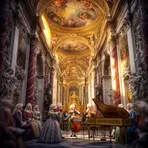
A time in Europe from about 1600 to 1750 when art, music, and buildings had a rich, detailed style
 1
8.1
1
8.1
A period in Europe from 1600 to 1750 when art, buildings, and music are dramatic and very decorated
Surface Forms
Morphology
The phrase is fully compositional: 'Baroque' names a specific artistic/historical style and 'period' denotes a span of time, so a B1 learner who knows both words will predictably understand 'Baroque period' as the time characterized by Baroque art and music. This noun+noun construction is common cross-linguistically (e.g., Spanish 'período barroco'), reinforcing its transparency.
Etymology
Baroque period may come from the Portuguese word 'barroco', which meant an odd or imperfect pearl. Because the art, music, and buildings of that time were very rich and full of decoration, people began to use the word to describe that ornate style and the period when it was made.