
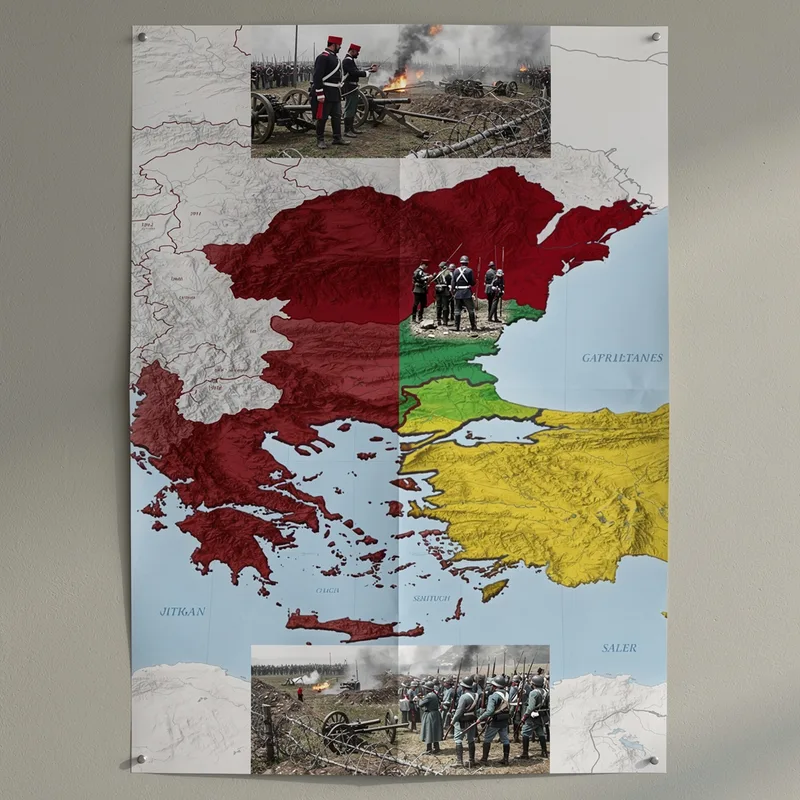
Balkan Wars
 1
7.8
1
7.8

- noun
- /ˈbɔlkən wɔrz/
- During the Balkan Wars (1912-1913), the Sakin Tepe Lines prevented the Bulgarian Army from attacking Istanbul.
- Balkan Wars of 1912
Examples
-
Although the Balkan League ultimately won a huge victory over the Turks in the First Balkan War, they soon fell to fighting each other over the spoils in the Second Balkan War in 1913.
Blog text (1) -
October 8, 1912: First Balkan War Begins
Blog text (1) -
During the Balkan Wars of 1912-13, almost half a million people left their traditional homelands, either voluntarily or by force.
Academic text (2008) -
On this date in 1912, Montenegro declared war on the Ottoman Empire, opening the First Balkan War and moving Europe one step closer to the conflagration looming in 1914.
Blog text (1) -
Kosovo itself reverted to Serbian control after the First Balkan War of 1912, in which Serbian, Bulgarian, and Greek armies drove out the weakened Turks.
Academic text (2007) -
The Balkan Wars in the early 20th century significantly altered the political landscape of Southeast Europe.
-
Many historians argue that the Balkan Wars set the stage for future conflicts in the region.
-
During the Balkan Wars, various nations fought over territories once controlled by the Ottoman Empire.
Surface Forms
Morphology
The headword combines a place-name 'Balkan' with the noun 'wars', so a learner who knows both constituents will understand it denotes armed conflicts in the Balkans. Although it refers to two specific historical conflicts (1912–1913), the core meaning is compositional and follows the common place-name + war pattern, making it immediately comprehensible.
Etymology
Balkan Wars: The name Balkan Wars comes from the place where the fighting happened — the Balkan region in southeast Europe. They were two major wars in 1912–1913 when several countries fought over the last European lands of the 'Ottoman Empire', so today the name refers to those two conflicts.