
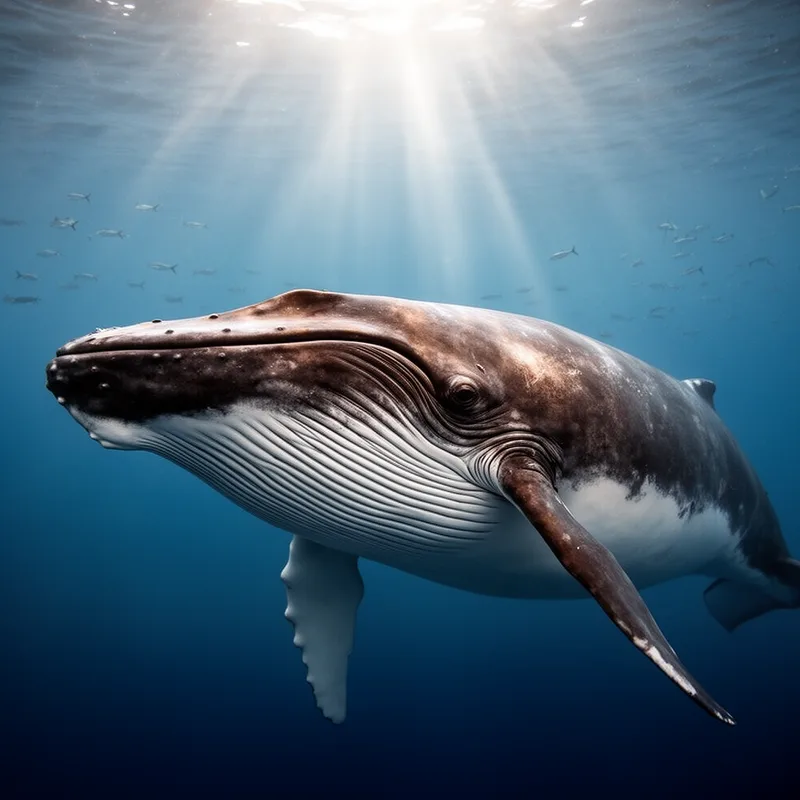
Balaenoptera physalus
- noun
- /ˌbæl.eɪ.nəˈpɪt.ər.ə ˈfaɪ.sə.ləs/
- Specialized
- Researchers tracked the migration patterns of Balaenoptera physalus across both the Atlantic and Pacific Oceans.
Examples
-
The Balaenoptera physalus is the second-largest species of whale in the world.
-
The Balaenoptera physalus is known for its impressive size and can reach lengths of up to 85 feet.
-
Researchers tracked the migration patterns of Balaenoptera physalus across the Atlantic Ocean.
-
Unlike the blue whale, Balaenoptera physalus has distinctive dark and light coloration.
-
The Balaenoptera physalus is the second largest whale species in the world.
-
Did you know that the Balaenoptera physalus can grow up to 85 feet long?
-
In contrast to other whales, the Balaenoptera physalus has unique deep furrows along its throat.
Synonyms

 3
4.0
3
4.0

A large whale with a flat head, long body and small back fin found in the Atlantic and Pacific

A large whale that has a flat head and deep lines on its throat, often called the fin whale

A large whale with baleen plates, a flat head, and throat ridges that lives in the Atlantic and Pacific Oceans

A very large whale with a flat head and deep grooves along its throat
Surface Forms
Morphology
Balaenoptera + physalus
Although the genus name Balaenoptera signals a group of large whales (so it gives a partial clue), the full binomial 'Balaenoptera physalus' is a taxonomic label and the species epithet 'physalus' is not a recognisable English word. A B1 learner who knows the listed constituents would not be able to derive the common meaning 'fin whale' without specialist/Latin knowledge, so the expression is treated as an opaque scientific name.
Etymology
Balaenoptera physalus comes from old words balaena 'whale' and ptera 'wing'. This gives the picture of a 'winged' whale because the fin whale's side fins look like small wings, and the second part physalus may come from a word about its shape or strong blow, so the name points to the animal we call the fin whale.