
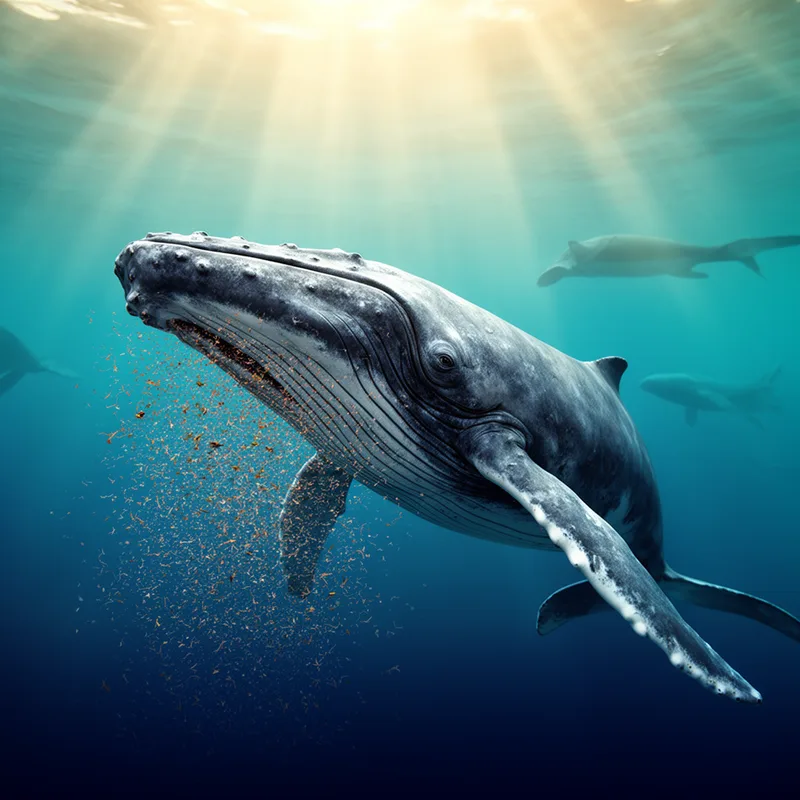
Balaenoptera musculus
- noun
- /bəˌleɪnəˈpɒtərə ˈmʌskjʊləs/
- Specialized
- The Balaenoptera musculus can reach lengths of over 30 meters, making it the largest animal to have ever lived.
Examples
-
Scientists have long studied the migratory patterns of Balaenoptera musculus in the Southern Ocean.
-
Marine biologists were excited to spot a pair of Balaenoptera musculus off the coast during their expedition.
-
The Balaenoptera musculus is a majestic creature.
-
Did you know that the Balaenoptera musculus can weigh up to 200 tons?
-
Marine biologists were excited to spot a pair of Balaenoptera musculus off the coast during their expedition.
-
Scientists have long studied the migratory patterns of Balaenoptera musculus in the Southern Ocean.
-
The Balaenoptera musculus can reach lengths of over 30 meters, making it the largest animal to have ever lived.
Synonyms
 211
1.4
211
1.4

A very large whale that is bluish grey and the largest animal ever

A very large blue-grey whale that migrates in southern oceans
Surface Forms
Morphology
This is a Latin scientific binomial (a taxonomic proper name), so its specific meaning ('blue whale') is not compositionally built from the two words in a way a B1 learner could predict. Although 'Balaenoptera' hints at large whales, species epithets like 'musculus' are arbitrary taxonomic labels (and here even misleading if interpreted as a mussel genus), so the overall referent requires specialized knowledge and is not derivable from the constituents.
Etymology
Balaenoptera musculus comes from old Latin and Greek words: Balaenoptera mixes 'whale' and 'wing' to give the image of the whale's long, wing-like fins, and musculus means 'little mouse', a name early scientists used for animals that looked small from far away. So the name paints a simple picture of the huge but distant animal we now call the blue whale.