

blue whale
 211
1.4
211
1.4

- noun
- /blu weɪl/
- The blue whale is known for its massive size, making it the largest animal to ever exist.
- blue whale abundance
- estimates of blue whales
- blue whales feeding
Loading YouTube…
Watch on YouTubeYou know, I mean, a blue whale's lungs are about the size of AVW.
- You know, I mean, a blue whale's lungs are about the size of AVW.
- Right now the best idea I have is a full blue whale skeleton that covers the entire inside of the forearm.
- But I looked up blue whale whales that that have teeth Orca orcas, orcas are are dolphins, right?
- And like the call of the blue whale, your heart could open and send new vibration into the cosmos that would reset the math of the whole matrix.
Examples
-
Yet, for unknown reasons, the blue whale is increasing in visibility and probably in numbers off the California coast.
Academic text (1993) -
But no one has ever tagged or tracked a blue whale to confirm the migration route.
Academic text (1993) -
Only one, the blue whale, is larger.
-
From the bridge, they can spot a blue whale two miles away.
Academic text (1993) -
"The blue whale's music can be heard for over 500 miles."
-
"The great blue whale is the largest animal to have ever existed."
-
There were once 300,000 blue whales in our oceans.
-
Virtually gone is the blue whale, the largest creature ever to inhabit the Earth.
-
There are plenty of mammals, from blue whales to California ground squirrels, but not all are easy to photograph.
Academic text (2006) -
Since 1986, Calambokidis has archived photos of 600 identifiable, individual blue whales seen in California waters.
Academic text (1993)
Synonyms

A very large blue-grey whale that eats small sea animals and lives in oceans worldwide
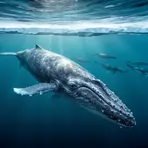
A very large blue-grey whale that migrates in southern oceans
How Big

Surface Forms
Morphology
The sense 'a dangerous online social-media challenge' is a culturally specific, named phenomenon that has no predictable connection to the literal constituents 'blue' (a color) and 'whale' (an animal or metaphorically a large person). Because the meaning depends on contemporary cultural knowledge rather than compositional semantics, a B1 learner who knows the words would not be able to infer this sense.
Etymology
Blue whale gets its name from the animal's bluish-grey skin and very large size, so blue shows its colour and whale shows it is a very large sea mammal.