
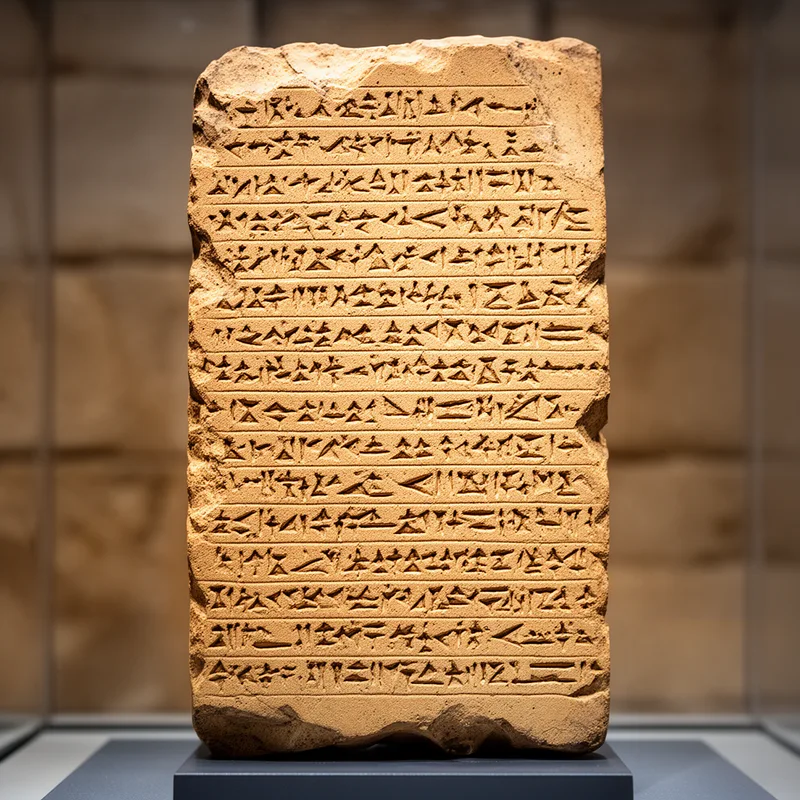
Babylonian tablet
- noun
- /ˌbæbəˈloʊniən ˈtæblɪt/
 :
tableta babilónica
:
tableta babilónica
- The museum's exhibit features a rare Babylonian tablet dating back to 1700 BCE.
Examples
-
Archaeologists discovered a Babylonian tablet detailing ancient trade transactions.
-
Many Babylonian tablets contain laws that governed daily life.
-
Students studied a Babylonian tablet to learn about early astronomical observations.
-
The Babylonian tablet is a crucial artifact for understanding ancient Mesopotamian culture.
-
Archaeologists discovered a Babylonian tablet detailing ancient trade transactions.
-
Students studied a Babylonian tablet to learn about early astronomical observations.
-
Many Babylonian tablets contain laws that governed daily life.
Synonyms

 50
1.8
50
1.8

A flat pad of paper used for writing or drawing
Surface Forms
Morphology
The meaning is directly compositional: 'Babylonian' (from Babylon) + 'tablet' (a flat writing object) yields a tablet associated with Babylon. Although specialized details like cuneiform script or historical context may not be known, a B1 learner who knows both constituents would understand the core referent, so the expression is transparent.
Etymology
Babylonian tablet is a clay tablet from ancient Babylon where writers pressed small wedge-shaped marks to 'record' things like 'laws', 'trade lists', or 'stories'. That's why today Babylonian tablet means an old clay tablet with ancient writing.