
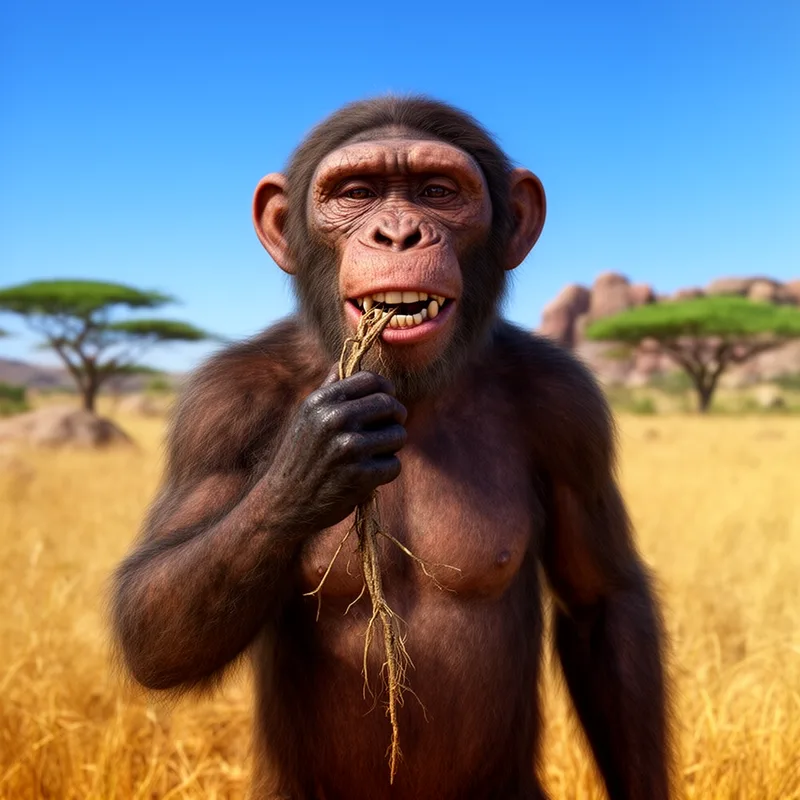
Australopithecus robustus
- noun
- /ˌɔːstrəloʊˈpɪθɪkəs roʊˈbʌstəs/
- Specialized
- Fossils of Australopithecus robustus have been found at several sites in South Africa.
Examples
-
Researchers believe that Australopithecus robustus had powerful jaws adapted for chewing tough plant material.
-
The discovery of Australopithecus robustus contributed significantly to our understanding of human evolution.
-
The Australopithecus robustus lived in southern Africa.
-
Did the Australopithecus robustus have large teeth?
-
Fossils of Australopithecus robustus have been found at several sites in South Africa.
-
Researchers believe that Australopithecus robustus had powerful jaws adapted for chewing tough plant material.
-
The discovery of Australopithecus robustus contributed significantly to our understanding of human evolution.
Surface Forms
Morphology
Australopithecus + robustus
The name combines a recognized genus label (Australopithecus = extinct hominid genus) with a Latin adjective (robustus ≈ 'robust'), so in principle the meaning 'a robust Australopithecus species' is compositional. However, this is a technical scientific binomial in Latin; many B1 learners will not know the taxonomic convention or the Latin epithet, so the sense is only partially predictable.
Etymology
Australopithecus robustus is a scientific name made of two parts: Australopithecus meaning 'southern ape' and robustus meaning 'strong'. Fossils with big teeth and powerful jaws were found in southern Africa, so the name shows it was a heavily built, ape-like species that lived long ago.

