

Asparagus plumosus
- noun
- Specialized
- The florist arranged delicate sprigs of Asparagus plumosus among the roses for added texture.
Examples
-
Gardeners value Asparagus plumosus for its graceful, trailing stems and easy maintenance indoors.
-
Asparagus plumosus is often mistaken for a true fern due to its light, feathery appearance.
-
I bought some Asparagus plumosus for my home decor.
-
Have you seen the Asparagus plumosus in the garden center?
-
Asparagus plumosus is often mistaken for a true fern due to its light, feathery appearance.
-
The florist arranged delicate sprigs of Asparagus plumosus among the roses for added texture.
-
Gardeners value Asparagus plumosus for its graceful, trailing stems and easy maintenance indoors.
Synonyms
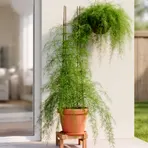
A climbing plant with soft feathery leaves used as a house or garden plant

A houseplant that has thin feathery leaves like a fern but is not a true fern
Surface Forms
Morphology
asparagus + plumosus
This is a Latin binomial combining the familiar English noun 'asparagus' with the Latin adjective 'plumosus' (meaning ‘feathery’). If a learner knew the meaning of 'plumosus' they could infer a ‘feathery/asparagus-like plant’, but because 'plumosus' is not an English word and the form functions as a taxonomic name rather than a regular compositional phrase, the semantic connection is only partially transparent to a typical B1 learner.
Etymology
Asparagus plumosus comes from two parts: Asparagus, the same word as the vegetable, and plumosus, which means 'feathery'. So the name gives a simple picture — an asparagus-type plant with light, feathery leaves, which explains why florists and gardeners use it for soft, airy texture.

