

Artemisia frigida
- noun
- Specialized
- In the summer, the Artemisia frigida blooms with small tawny florets that attract various insects.
Examples
-
The landscape was dotted with the silvery green foliage of Artemisia frigida.
-
The Artemisia frigida thrives in dry, northern climates.
-
Artemisia frigida thrives in dry, rocky soils across the northern prairies.
-
Her research focused on the medicinal properties of Artemisia frigida leaves.
-
Can you identify the Artemisia frigida among these plants?
-
Artemisia frigida is commonly used in traditional medicine for its healing properties.
-
While hiking through the northern plains, we encountered patches of Artemisia frigida growing in the sunlight.
Synonyms
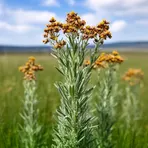
A perennial plant with soft, fragrant leaves and brownish-yellow flowers

A plant with soft leaves and a strong smell that lives for many years and has small brownish flowers
Surface Forms
Morphology
Artemisia + frigida
The binomial is compositionally informative: 'Artemisia' names the plant genus and 'frigida' (from Latin/English root meaning 'cold' or 'frigid') signals an association with cold, so a learner who knows both constituents could infer it is a species of Artemisia found in cold/dry northern areas. However, the precise botanical attributes in the definition (silky‑leaved, aromatic perennial, fringed sagebrush) are specialized and not predictable from the constituents alone, so the meaning is only partially transparent.
Etymology
Artemisia frigida comes from two parts: Artemisia, an old Greek name used for strong-smelling plants, and frigida, a Latin word meaning 'cold'. So the name helps you remember that this silvery-leaved plant has a strong smell and lives in dry, cold northern places.

