
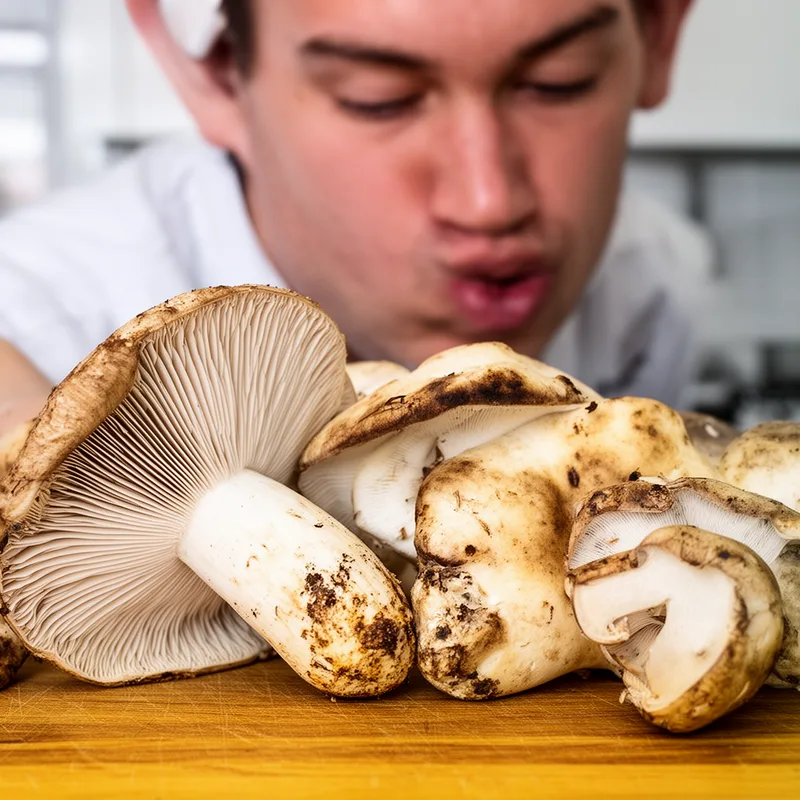
Armillaria ponderosa
- noun
- /ɑːrˈmɪl.ə.ri.ə pɒnˈdɛr.ə.sə/
- Specialized
- The gills of Armillaria ponderosa are bright white when young but darken with age.
Examples
-
Chefs in the Pacific Northwest prize Armillaria ponderosa for its distinctive flavor in Asian-inspired dishes.
-
We found several clusters of Armillaria ponderosa while hiking in the damp forest.
-
The chef used Armillaria ponderosa in the soup.
-
Have you ever tasted Armillaria ponderosa?
-
Chefs in the Pacific Northwest prize Armillaria ponderosa for its distinctive flavor in Asian-inspired dishes.
-
The gills of Armillaria ponderosa are bright white when young but darken with age.
-
We found several clusters of Armillaria ponderosa while hiking in the damp forest.
Synonyms

A large white mushroom with a spicy smell used in Asian cooking
Surface Forms
Morphology
Armillaria + ponderosa
The phrase is a taxonomic binomial: knowing 'Armillaria' (a genus of mushrooms) lets a learner infer this is a species of that mushroom genus, so the basic class membership is compositional. However, the species epithet 'ponderosa' is a Latin name element that carries no clear, predictable lexical meaning for a B1 learner and the specific properties (edible, white gills, brown stains, aroma) cannot be derived from the constituents, making the overall interpretation only partially transparent.
Etymology
Armillaria ponderosa comes from Latin words that describe the mushroom. The first word, Armillaria, comes from 'armilla' ('bracelet') because these mushrooms often have a ring on the stem, and the second word, ponderosa, means 'heavy' or 'large', so the name helps you remember it is a big, ringed edible mushroom.

