
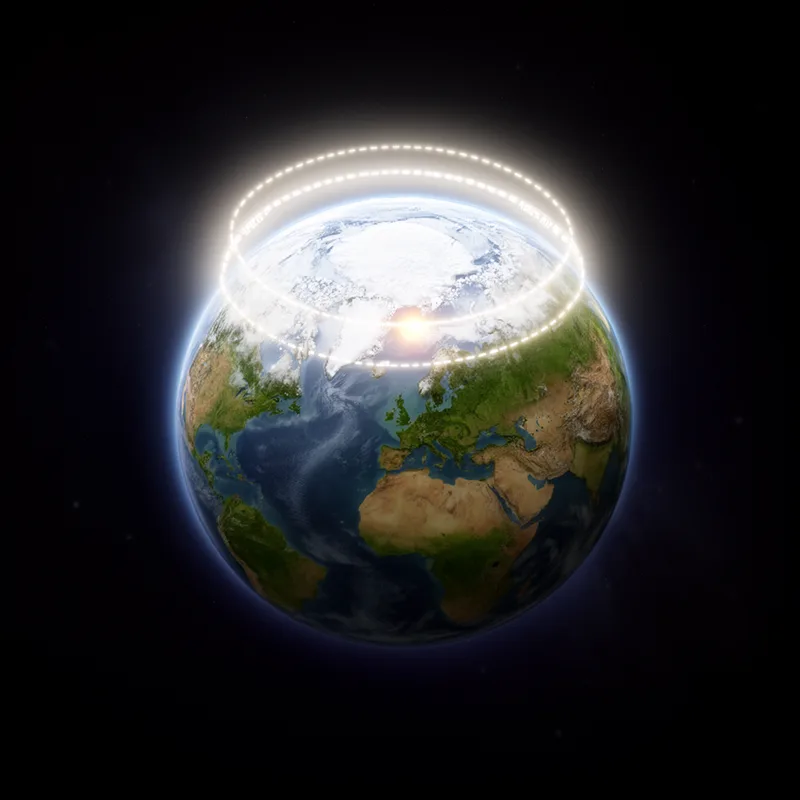
Arctic Circle
 11
3.7
11
3.7

- noun
- /ˈɑrk.tɪk ˈsɜr.kəl/
- Students learned that the Arctic Circle is where the sun remains visible for 24 hours during midsummer.
- north of the Arctic Circle
- south of the Arctic Circle
Loading YouTube…
Watch on YouTubeEvening and welcome to Yuka Scarvy in the Arctic Circle in northern Sweden.
- Evening and welcome to Yuka Scarvy in the Arctic Circle in northern Sweden.
- You mentioned briefly drilling for oil and gas in the Arctic Circle and some of that lies in Russia.
- How do you think you would respond if you lived up in the Arctic Circle and when winter came, the sun was bye, bye for months.
- And actually, they're reviled by, from what I understand, by native hunters above the Arctic Circle for being wasteful hunters.
- I surfed a wave above the Arctic Circle in the winter.
- But when I went to the Arctic Circle last year, one of my Water Tiger members saw trees.
- It's like people that are in Arctic Circle and they stop having like radio signal and they have to go back to civilization.
- Yeah, yeah, I just came back from from Svalbard, which is where's that it's it's in the Arctic Circle.
Examples
-
We're in central Alaska, the Big Lonely, just north of the Arctic Circle.
Fiction book (1993) -
One of these special places is at Sasskam, near the town of Jokkmokk on the Arctic Circle.
Academic text (2008) -
Because north of the Arctic Circle is the only place we'll be safe.
-
In fact, he was one of the first to explore the Arctic Circle, which is a big deal.
-
I am not sure how much heat loss takes place above the Arctic Circle.
Blog text (33) -
If you go to the Arctic Circle, you will, for example, experience two months with the midnight sun.
Blog text (9) -
So when you hit the Arctic Circle, there is a day where the sun never sets and it stays that way throughout the summer.
-
I am currently in Lapland inside the Arctic Circle in Finland.
-
The polar bear is found mainly in the Arctic Circle and the adjacent land masses as far south as Newfoundland island.
-
In Greenland and elsewhere along the Arctic Circle, researchers are taking samples of polar bear skin and fat and examining bear skulls collected over several decades.
Academic text (2012)
Synonyms

A circle near Earth's poles where the sun stays above or below the horizon for one day
Surface Forms
Morphology
The meaning is directly compositional: 'Arctic' names the far-north region and 'circle' signals a circular boundary, so learners can infer this refers to the (imaginary) latitudinal line/zone marking the Arctic edge. This construction is literal and cross-linguistically common, so a B1 learner who knows both constituents can reasonably understand the term.
Etymology
Arctic Circle comes from the word Arctic, which comes from an old word for 'bear' because a well-known star group called the Great Bear sits in the northern sky. The word Circle means a round line, so the name labels the round line near the north where, for some days each year, the sun does not set in summer or does not rise in winter.