
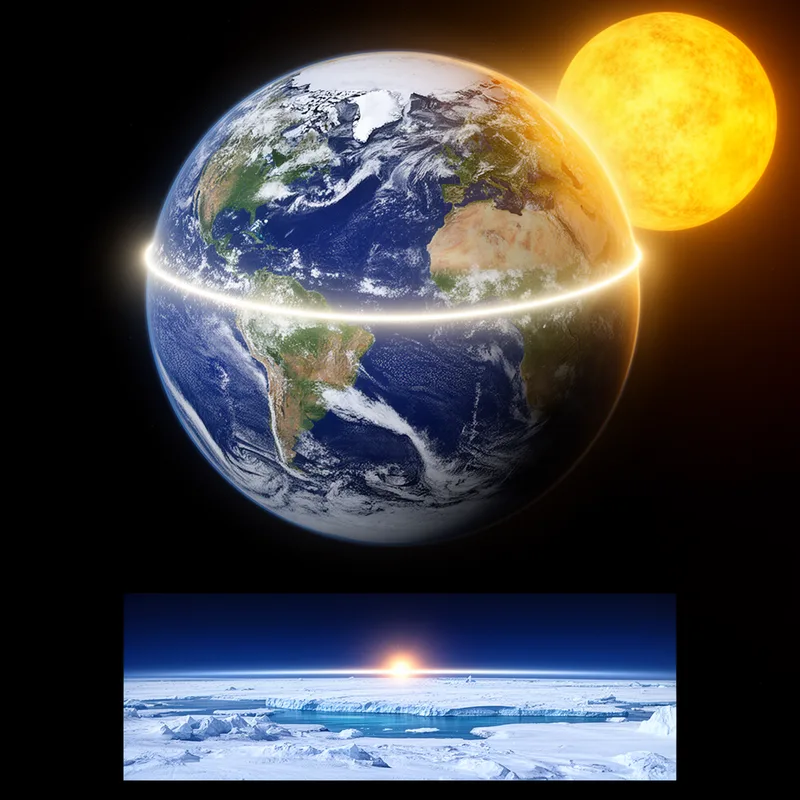
polar circle
- noun
- /ˈpoʊlər ˈsɜrkl/
- Many researchers study the unique ecosystems found within the polar circle in both the Arctic and Antarctic.
Examples
-
The celestial north and south polar circles, tropics, and equator now have geographical counterparts on Earth.
Academic text (1997) -
The sun does not rise above the horizon in the Arctic region inside the polar circle during winter.
-
Travelers often experience continuous daylight when visiting locations within the polar circle during the summer months.
Surface Forms
Morphology
The meaning is directly and transparently derived from 'polar' (relating to the poles/Arctic–Antarctic) and 'circle' (a round line), so a learner who knows both words can infer it denotes a circular line around the poles. While technical details (exact latitude or daylight phenomena) are specialised, the basic referent—a circle near the poles—is compositionally clear and cross-linguistically common.
Etymology
Polar circle comes from a simple picture: a polar (near the North or South Pole) circle drawn around the Earth to show the area where, for at least one day each year, the 'sun does not set' in summer or 'does not rise' in winter. So the phrase means the line that marks that special area around the poles.

