
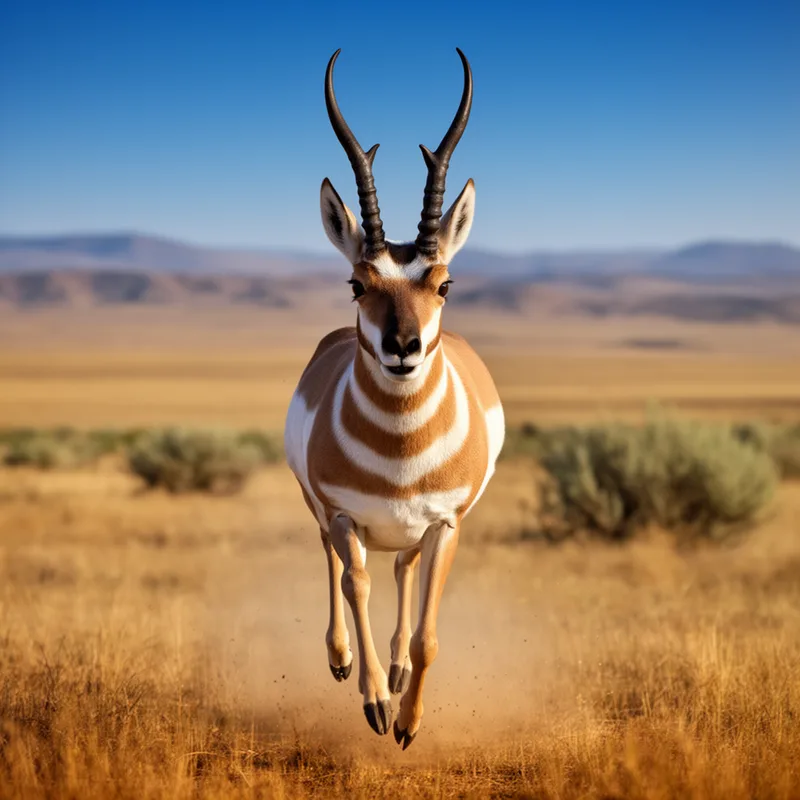
Antilocapra americana
- noun
- /ˌæntɪloʊˈkæprə əˈmɛrɪkən/
- Specialized
- The Antilocapra americana is uniquely adapted to outrun predators on the open plains.
Examples
-
Unlike true antelopes, Antilocapra americana has horns that are shed and regrown annually.
-
Scientists tracked the migration routes of Antilocapra americana across the western United States.
-
The Antilocapra americana is known for its incredible speed.
-
Did you see the Antilocapra americana at the wildlife reserve?
-
Scientists tracked the migration routes of Antilocapra americana across the western United States.
-
The Antilocapra americana is uniquely adapted to outrun predators on the open plains.
-
Unlike true antelopes, Antilocapra americana has horns that are shed and regrown annually.
Synonyms
 3
8.4
3
8.4

A fast, deer-like animal from western North America with small branched horns

 1
8.0
1
8.0
A fast North American animal like an antelope with small forked horns on open plains

An animal like a small antelope with short branched horns that runs fast on open plains
A fast, hoofed animal from western North America called the pronghorn
Surface Forms
Morphology
Antilocapra + americana
This is a Latin binomial combining the genus name 'Antilocapra' (a fast-running North American mammal) with the species epithet 'americana', which conventionally signals ‘from America’; therefore the sense 'the American species of Antilocapra (pronghorn)' is directly derivable from the parts. Binomial taxonomic formation is a regular and cross-linguistic pattern, so a learner who knows both constituents would comprehend the meaning without special idiomatic knowledge.
Etymology
Antilocapra americana is the scientific name that joins antilo meaning 'antelope' and capra meaning 'goat', with 'americana' showing its American home. People chose this name because the 'pronghorn' looks like both an antelope and a goat and lives on the wide North American plains, so the name helps you remember this fast, horned mammal.