
Abstract Expressionism
 1
9.1
1
9.1

- noun
- /ˈæbstrækt ˌɛkspəˈrɛʃənɪzəm/
- Specialized
- One view, professed most passionately by Clement Greenberg between the 1940s and the 1960s, was to publicize such New York-based movements as Abstract Expressionism.
Loading YouTube…
Watch on YouTubeBut it was at that point that Irwin chose to move away from Abstract Expressionism and really toward exploring the ideas of perception in his paintings.
- But it was at that point that Irwin chose to move away from Abstract Expressionism and really toward exploring the ideas of perception in his paintings.
Examples
-
For five years beginning in 1955, she was an art critic for The New York Times, where she championed abstract expressionism—an advocacy that didn't sit well with her editors, she told me.
Academic text (2011) -
New York at the time was under the spell of Abstract Expressionism, but Kusama's first show in New York consisted of what she called Infinity Net paintings.
-
TV is neither less nor more legitimate an influence than, for example, New York Abstract Expressionism.
Academic text (2000) -
In this film we look at Abstract Expressionism, it's origins in New York City and works in three lesser known museums by three artists.
-
I would even say that he took it upon himself to address the question of the legacy of Abstract Expressionism head-on.
Academic text (2005) -
Eventually, of course, Abstract Expressionism ran its course, and so did the art historical formalism that dominated midcentury writings about Pre-Columbian art.
Academic text (2013) -
The influences of Surrealism, Photo-Realism, and even Abstract Expressionism are all detectable in the artworks created on the occasion of Aristide's homecoming.
Academic text (1996) -
Art criticism focuses on the authenticity of feeling in O'Keeffe's abstract work; the term abstract expressionism is a marvelously handy portmanteau for what is of aesthetic value in such pieces.
Academic text (2007) -
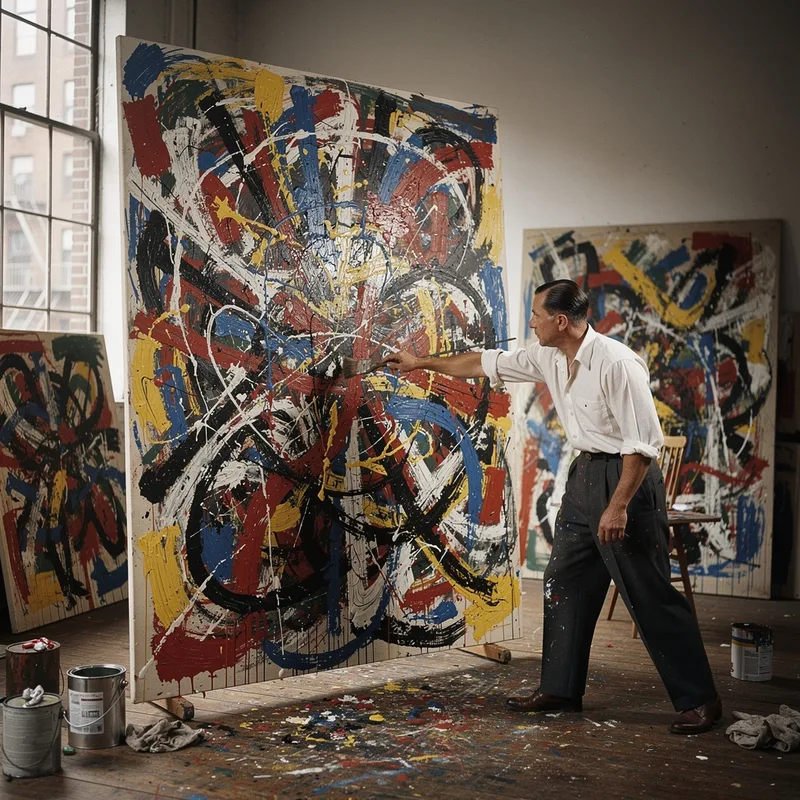
Abstract Expressionism emerged in New York in the 1940s, characterized by its spontaneous brushwork and abstract forms.
-
Many artists consider Abstract Expressionism to be a pivotal movement in the history of American art.
How Spontaneous
- Specialized
1
9.1

- Specialized
6
8.7
6
7.9
12
6.1
- Specialized
Surface Forms
Morphology
The term is a direct combination of 'abstract' (non-representational art) and 'expressionism' (a style emphasizing emotional experience), so a learner who knows both words can infer it denotes an art style emphasizing abstract, expressive painting. While historical specifics (New York, 1940s) are not deducible, the core meaning is compositional and cross-linguistically transparent.
Etymology
Abstract Expressionism began in 1940s New York when painters made very large works with quick movements, drips, and splashes instead of clear pictures. The name joins abstract ('not a clear shape') and expressionism ('showing feeling'), so it describes paintings that use shape and brush strokes to 'show feelings' rather than copy reality.