
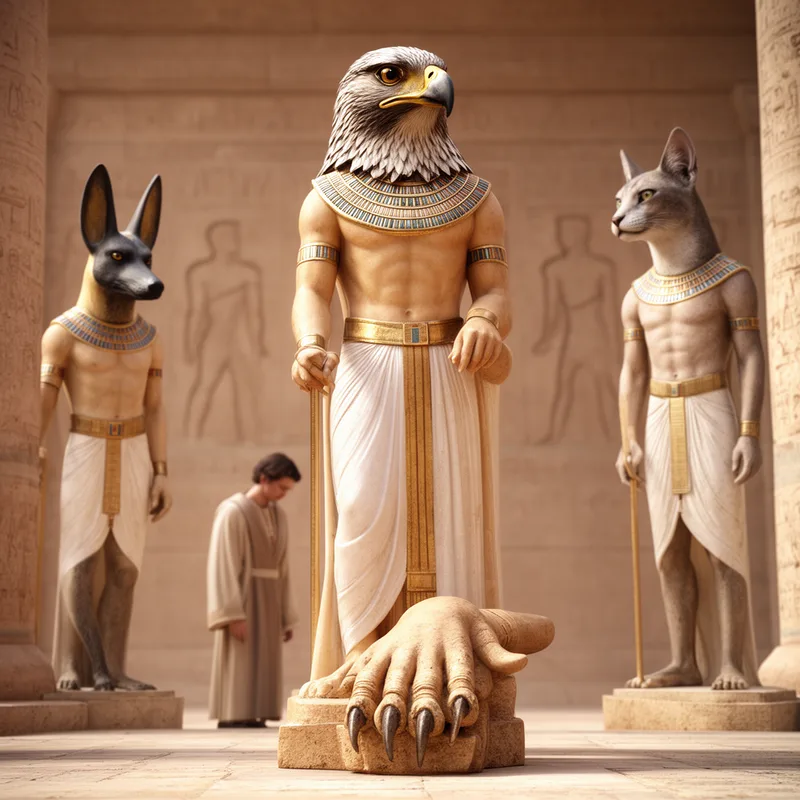
zoomorphism
- noun
- /zuːˈmɔːrfɪzəm/
- Literature
- Many ancient cultures employed zoomorphism in their art, depicting gods with animal features.
Examples
-
They are undecidable in their lifelikeness; there is possibly a whiff of blasphemy in the zoomorphism of Gehry's cathedral.
Academic text (1999) -
Still, zoomorphism is a minor rill in the modern architectural stream.
Academic text (1999) -
The computer that is enabling him to replace geometric abstraction with zoomorphism has simply made Gehry.
Academic text (1999) -
The sculptor's use of zoomorphism transformed ordinary objects into creatures with lifelike qualities.
-
In literature, the author skillfully integrates zoomorphism by describing characters with animalistic traits.
Synonyms
Showing a person or thing as an animal
How Animal-Like
- Literature
 2
8.1
2
8.1

 12
6.1
12
6.1
- Literature
1
6.8
6
8.0
Surface Forms
Morphology
Etymology
Zoomorphism comes from Greek parts zoo- meaning 'animal' and -morph meaning 'form' or 'shape', the same zoo- you see in 'zoo' and 'zoology'. So, zoomorphism means giving animal forms or traits to gods, people, or things, which is why a statue with a human body and an animal head is called zoomorphic.