
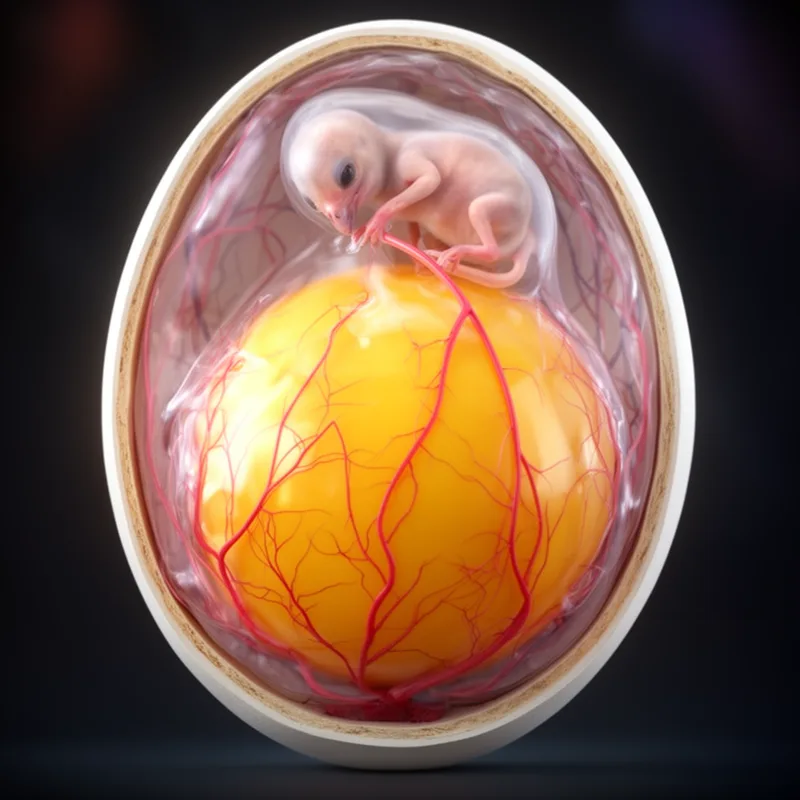
yolk sac


 1
7.4
1
7.4
- noun
- /joʊk sæk/
- Specialized
- Newly hatched larvae of lutjanids, in general, are typical of those from fish with small pelagic eggs; the larvae have a large yolk sac, unpigmented eyes, and no mouth.
Examples
-
In many species, the yolk sac serves as the first means of nutrient transfer during early development.
-
At this stage, the energetic supply to the developing organism is provided by the yolk sac.
Academic text (2016) -
The functions of the yolk sac placenta are unknown, but it has been suggested to function in water transport.
Academic text (1993) -
During the first hours of a larva's planktonic existence, it is sustained by a small yolk sac.
Academic text (2002) -
Once the yolk sac is absorbed, the larvae are slender and rodlike.
Academic text (1991) -
The yolk sac typically lasts 3-4 days, after which the mouth is fully formed and the eyes become pigmented (Leis, 1987).
Academic text (1993) -
INS imprinting has been analyzed previously, but only in the pancreas and the yolk sac of mice and humans.
Blog text (26) -
The omphalomesenteric duct or vitelline duct connects the yolk sac to the gut in the developing embryo and provides nutrition until the placenta is established.
Academic text (2007) -
The yolk sac provides essential nutrients to the developing embryo before it can feed on its own.
-
As the embryo grows, it gradually absorbs the yolk sac, depending on it for sustenance in its early stages.
Synonyms
A small sac in early mammal embryos that carries blood and nutrients before the heart works

A thin bag in early embryos that carries blood and nutrients before the heart works

A thin membrane in early mammal embryos that carries blood until the heart begins to beat
The yolk inside an egg or the yolk sac that feeds an embryo
Surface Forms
Morphology
The compound is directly compositional: 'yolk' (the nutrient-rich part of an egg) plus 'sac' (a container or membranous structure) straightforwardly denotes a membrane/room associated with the yolk. Although the term is technical, its basic function—a sac containing/associated with the yolk that supplies nutrients—is predictable from the constituents, so a B1 learner who knows both words would grasp the general meaning.
Etymology
The noun yolk sac names a small, thin bag around the yolk in an embryo. The picture is clear: the sac wraps the yolk, which is full of food, so it 'provides nutrients' and helps make early blood for the developing animal, which is why the name describes its job.