
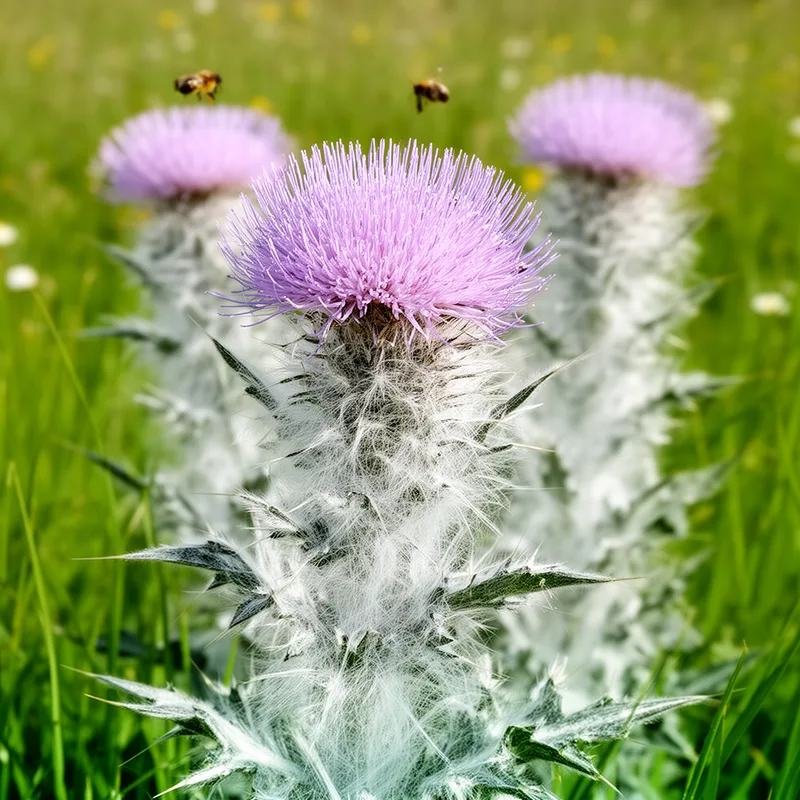
woolly thistle
- noun
- UK
- The woolly thistle is easily recognized by its pale purple flowers and distinctive hairy stems.
Examples
-
I saw a cluster of woolly thistle growing wild along the edge of the meadow.
-
Gardeners sometimes plant woolly thistle to attract bees and butterflies to their gardens.
-
The woolly thistle blooms beautifully in late summer.
-
Have you seen the woolly thistles in the garden?
-
Gardeners sometimes plant woolly thistle to attract bees and butterflies to their gardens.
-
I saw a cluster of woolly thistle growing wild along the edge of the meadow.
-
The woolly thistle is easily recognized by its pale purple flowers and distinctive hairy stems.
Synonyms
A tall thistle with woolly stems and large purple flower heads

A tall thistle with soft white hairs that grows in parts of Europe
Surface Forms
Morphology
This is a simple adjective+noun composition: 'woolly' describes the texture/appearance and 'thistle' names the plant, so the meaning (a thistle that is woolly) is directly derivable from the parts. Modifier+noun descriptive patterns are cross-linguistically common, so a B1 learner who knows both words can infer the MWE's meaning.
Etymology
Woolly thistle: The plant name woolly thistle comes from how the plant looks — its stems and leaves are covered in white, soft hairs that make it seem woolly, and thistle shows it is a prickly plant, so the name points to a prickly plant with a wool-like covering.

