

European woolly thistle
- noun
- UK
- The leaves of the European woolly thistle are covered in dense, white hairs.
Examples
-
The European woolly thistle can reach heights of up to two meters in the wild.
-
Gardeners in the region sometimes cultivate European woolly thistle for its striking appearance.
-
The European woolly thistle grows abundantly in the wild.
-
Is the European woolly thistle found in your area?
-
Gardeners in the region sometimes cultivate European woolly thistle for its striking appearance.
-
The European woolly thistle can reach heights of up to two meters in the wild.
-
The leaves of the European woolly thistle are covered in dense, white hairs.
Synonyms
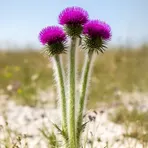
A tall thistle with woolly stems and large purple flower heads
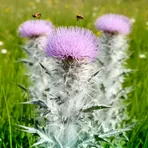
A prickly plant with pale purple flowers and hairy white stems and leaves
Surface Forms
Morphology
The noun phrase simply combines the meanings of its parts: a thistle (spiky plant) that is woolly in texture and associated with Europe, so a learner who knows 'European', 'woolly' and 'thistle' can infer the referent. This adjectival stacking is a common, compositional pattern in English (and other languages), making the phrase directly understandable without prior exposure.
Etymology
European woolly thistle gets its name from how it looks and where it grows: European shows it comes from 'Europe', woolly refers to the thick white hairs that look like 'wool', and thistle is a spiky wild plant. So, the name simply describes a spiky plant with wool-like hairs from Europe.

