
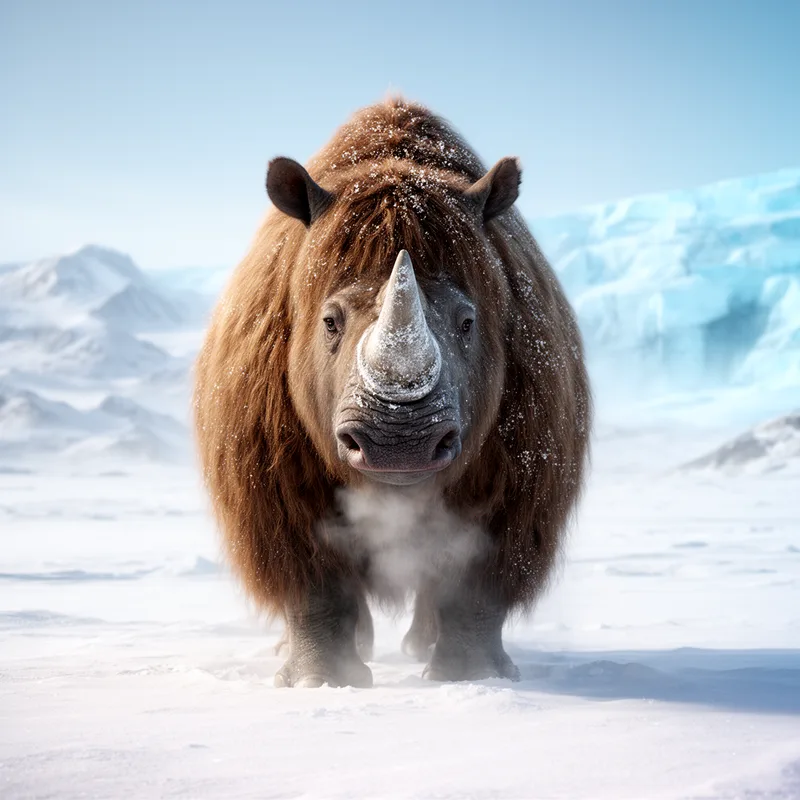
woolly rhinoceros


 1
8.6
1
8.6
- noun
- /ˈwʊli raɪˈnɒsərəs/
- The woolly rhinoceros roamed the frozen tundra during the Ice Age, adapted to the harsh Arctic climate.
- mammoths and woolly rhinoceroses
Examples
-
The woolly mammoth wasn't the only massive hairy creature, as the woolly rhinoceros also stomped through the Arctic snow as recently as 10,000 years ago.
Blog text (11) -
Scientists discovered fossils of the woolly rhinoceros in Siberia, helping to understand prehistoric life.
-
The thick fur of the woolly rhinoceros protected it from the extreme cold of its Ice Age habitat.
Synonyms
A large extinct rhinoceros with thick fur that lived in Arctic regions during the Ice Age
Surface Forms
Morphology
The compound is a straightforward adjective+noun combination: 'woolly' describes a wool-like, hairy coat and 'rhinoceros' names the animal, so the meaning ('a rhinoceros with a woolly coat') is directly derivable from the parts. This follows a common compositional pattern found across languages, so a B1 learner who knows both words would readily understand the MWE even without background knowledge about its Ice Age or extinct status.
Etymology
The noun woolly rhinoceros comes from the animal's look in the Ice Age: it had a thick, wool-like coat and a large horn on its nose. People found frozen bones and skins in places like Siberia, so the name links woolly ('hairy') and rhinoceros ('nose with a horn') to the extinct animal we mean today.