

woolly manzanita
- noun
- /ˈwʊli ˌmænzəˈniːtə/
- US
- The young branches of woolly manzanita are covered in a dense, fuzzy coating.
Examples
-
The woolly manzanita thrives in the dry hills of California.
-
We saw several woolly manzanitas along the hiking trail.
-
The woolly manzanita thrives in California's coastal regions.
-
I spotted a woolly manzanita while hiking in the hills.
-
The woolly manzanita grows well in the dry, rocky soil of California.
-
During our hike, we admired the beautiful woolly manzanita with its soft, fuzzy branches.
-
In the spring, the woolly manzanita produces small white flowers that attract pollinators.
Synonyms
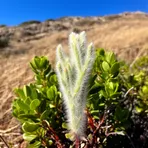
A shrub with young hairy stems that grows in California

A shrub native to California that grows upright with open branches and soft, hairy young twigs
Surface Forms
Morphology
This is a straightforward adjective + noun combination: given 'woolly' (covered with wool-like hairs) and 'manzanita' (a small tree/shrub), a B1 learner can infer it is a manzanita with woolly hairs. The pattern is a standard descriptive NP (adj + noun) and is cross-linguistically common, so the meaning is directly derivable from the parts.
Etymology
Woolly manzanita gives a clear picture: woolly means covered in soft, fuzzy hairs and manzanita comes from Spanish for 'little apple' because the plant makes small round fruits. So the name means a California shrub with fuzzy young twigs and apple-like berries.

