

woolly mammoth
 4
5.2
4
5.2

- noun
- /ˈwʊli ˈmæməθ/
- A mother and daughter peer through enormous woolly mammoth tusks lodged in permafrost at the Discovery Channel's Prehistoric Worlds exhibit.
- woolly mammoths and reindeer
Loading YouTube…
Watch on YouTubeThey're seeking to restore lost ecosystems and use gene editing to restore the woolly mammoth to the Arctic tundra.
- They're seeking to restore lost ecosystems and use gene editing to restore the woolly mammoth to the Arctic tundra.
- And the wonder of it is in some ways is how we humans did not go the way of the woolly mammoths.
- Like how if you find DNA in the ice and you can like, we can make a new woolly mammoth or some whatever scientists are doing right now that scares me.
- And then let's do a woolly mammoth.
- You know, I bet if they had a newborn baby, if they're riding on a woolly mammoth, they just plop that right in there.
Examples
-
Sometimes it's a woolly mammoth, frozen for thousands of years in the icy ground.
Blog text (32) -
Spear-toting hunters chased bison or surrounded a woolly mammoth in some of the images, while other paintings depicted tribal life in the Paleolithic and Neolithic.
Academic text (2009) -
Do you know someone's trying to clone a woolly mammoth?
-
Typical animals hunted by Lucy would have been wild horses, woolly mammoths, reindeer, and rhinos.
Academic text (1999) -
They're seeking to restore lost ecosystems and use gene editing to restore the woolly mammoth to the Arctic tundra.
-
Paleontologists believe Wrangel is also the last place where woolly mammoths lived.
-
Researchers deciphered the genomes of two woolly mammoths that died about 20,000 and 60,000 years ago.
-
The Peak: Things got pretty quiet in these parts after the woolly mammoths disappeared about 10,000 years ago.
Synonyms
 47
5.5
47
5.5
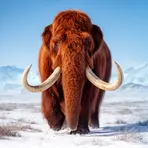
A very large, hairy elephant that lived long ago with curved tusks

A large, hairy extinct elephant that lived in cold northern areas during the Ice Age

A very large, hairy animal like an elephant that lived in cold northern places
Surface Forms
Morphology
The noun phrase is fully compositional: 'woolly' (having a thick, wool-like coat) modifies 'mammoth' (a prehistoric elephant), so the meaning 'a mammoth with a thick coat of hair' is directly derivable from the parts. This is a standard adjective + noun description common cross-linguistically and would be immediately understandable to a B1 learner who knows both constituents.
Etymology
Woolly mammoth: The name woolly mammoth shows the animal's look: woolly means 'covered in thick hair', and mammoth was a word people used for very large animals whose tusks were often found buried in the ground. So the name makes you picture a huge, hairy elephant from the Ice Age, which is the animal we mean today.