

woolly bear
 1
7.7
1
7.7

- noun
- /ˈwʊli bɛr/
- US
- During the fall, a woolly bear crawls slowly across the road in search of food.
- woolly bear caterpillar
Examples
-
She focused on another woolly bear, a scrappy one, more orange than black, which had ventured out at a good pace from Elaine Shore's asphalt driveway across the road.
Fiction book (2002) -
And only after all that miraculous survival did a woolly bear build its cocoon and begin its transformation.
Fiction book (2002) -
Some woolly bear caterpillars, for example, normally eat lupines.
Academic text (2000) -
With their bellies full of dandelion greens and native plantains, these orange-and-black-banded woolly bears travel at about four feet per minute, in search of niches where they can spend the winter.
Fiction book (2002) -
The woolly bear caterpillar has thick, soft hairs that help it survive harsh winters.
-
After several months of eating, the woolly bear will find a safe place to spin its cocoon.
Synonyms
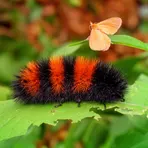
A hairy caterpillar with thick, stiff hairs that turns into a small moth

A hairy caterpillar with a thick, fuzzy coat and dark bands
Antonyms

Surface Forms
Morphology
woolly + bear
Knowing 'woolly' and 'bear', a B1 learner will likely infer a hairy or fluffy creature called a 'bear', so the general notion of a woolly animal is derivable from the parts. However, the specific referent (a caterpillar species rather than an actual bear) is not predictable from the constituents, making the expression only partially compositional.
Etymology
Woolly bear comes from the caterpillar's look: its thick, woolly hairs made people think it looked like a tiny furry bear. So the name now means this fuzzy 'caterpillar' and the picture helps people remember it.