
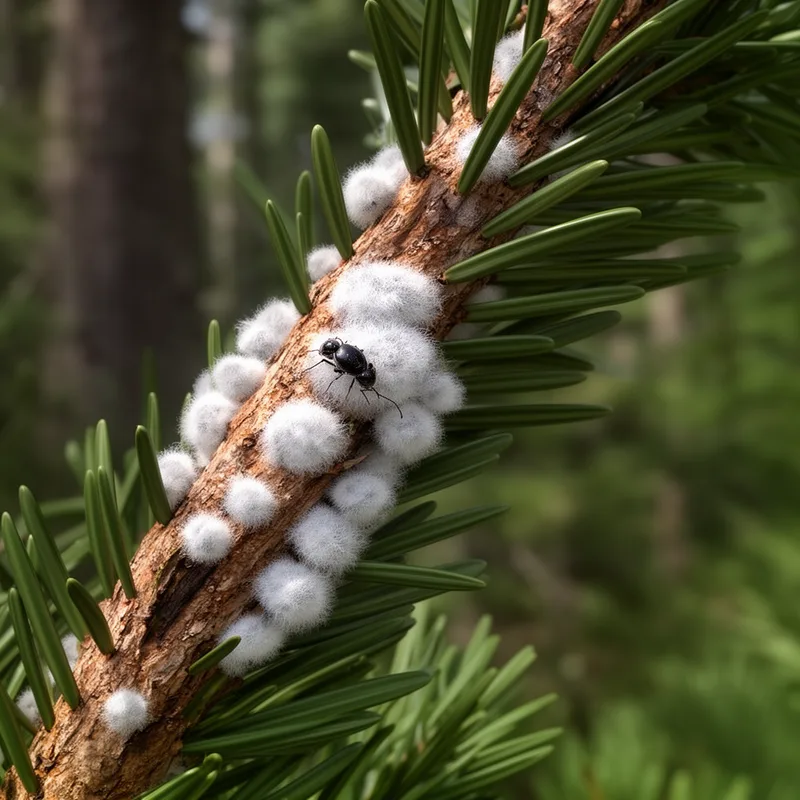
woolly adelgid
- noun
- /ˈwʊli əˈdɛlʤɪd/
- Specialized
- To control the spread of the woolly adelgid, researchers are experimenting with natural predators like beetles.
- hemlock woolly adelgid
Examples
-
Newly introduced herbivores, such as the hemlock woolly adelgid and the Asian long-horned beetle, threaten the composition and integrity of much natural and managed vegetation.
Academic text (2008) -
With the combination of increasing temperatures and the potential selection for greater cold tolerance within hemlock woolly adelgid populations, eastern hemlock trees could be affected by this pest throughout their entire range within the next 30 years (Albani et al. 2010).
Academic text (2012) -
The woolly adelgid is harming hemlock trees by sucking their sap and causing them to die.
-
Scientists study the impact of the woolly adelgid on forest ecosystems, particularly its effect on hemlocks.
Synonyms


 1
9.9
1
9.9
A small insect that eats needles of pine and spruce trees and makes plant growths

A small insect that looks like white cotton on plants and sucks their juice
A small insect that makes a white, cotton-like covering on plants
Surface Forms
Morphology
This is a straightforward adjectival noun combination: 'woolly' (having a wool-like, fluffy appearance) modifies 'adelgid' (an insect), so the phrase denotes an adelgid with a woolly appearance. The meaning is compositionally predictable from the constituents and follows a common descriptive pattern, so a learner who knows both words would understand it.
Etymology
Woolly adelgid gets its name from the white, wool-like clumps that cover the insect and its eggs: woolly points to those fluffy, cottony masses and adelgid is the small insect that sucks sap from hemlock trees. So, when you see white cotton on hemlock branches, those 'woolly adelgids' are likely feeding and can damage the trees.