
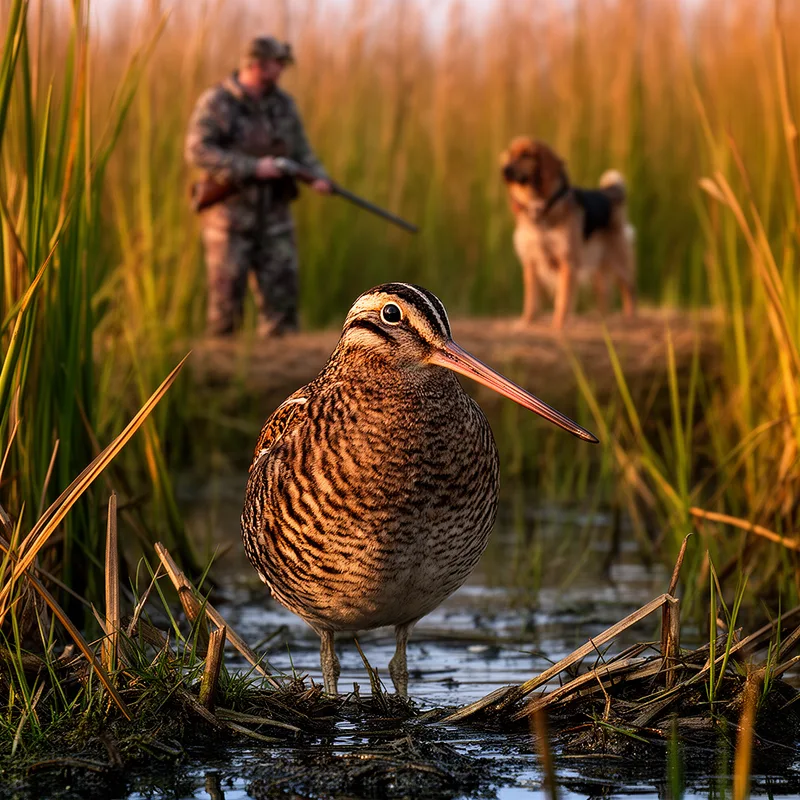
woodcock snipe
- noun
- Many hunters seek the elusive woodcock snipe for both sport and culinary enjoyment.
Examples
-
The woodcock snipe is often sighted in dense marshlands during the spring migration.
-
Many hunters seek the woodcock snipe during the season.
-
Birdwatchers traveled far to add the elusive woodcock snipe to their observation lists.
-
Compared to the common snipe, the woodcock snipe appears noticeably larger and darker.
-
The woodcock snipe is known for its elusive nature.
-
During their outing, the birdwatchers were thrilled to spot a beautiful woodcock snipe in the wetland.
-
The woodcock snipe is valued by both birdwatchers and hunters alike for its unique characteristics.
Synonyms

 5
8.1
5
8.1

A brown game bird with a long beak and short legs that lives in forests
 1
3.2
1
3.2
A bird like a pheasant that people hunt for food or sport

A small North American bird with a long bill that lives in wet fields

A small North American bird with a long bill that uses it to find worms and people hunt for food

A North American bird with a long bill that makes a spiral flight during mating season

A group of birds that includes the American woodcock

A short-legged, long-billed bird with mottled brown feathers that migrates across Europe and Asia

A group of woodcock birds found in Europe and Asia
Surface Forms
Morphology
The phrase is a transparent noun–noun compound built from two literal bird names: 'woodcock' and 'snipe', so its meaning as a kind of bird (or a snipe related to/like a woodcock) is directly inferable from the parts. Noun compounding to label species is cross-linguistically common, so a B1 learner who knows both constituent words can reasonably understand the MWE even if they lack precise taxonomic detail.
Etymology
Woodcock snipe may come from people saying the bird looked like both a woodcock and a snipe — two shy, long-billed birds that live in wet woods and marshes. Saying both names made a clear picture for hunters and birdwatchers, so the name came to mean this small, long-billed bird often hunted as a 'game' bird.