
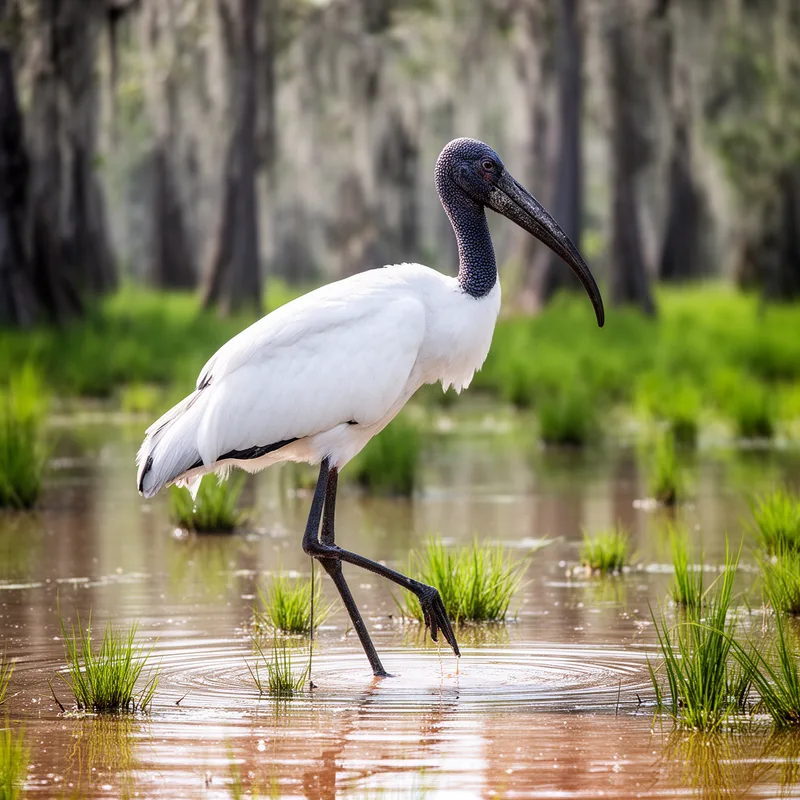
wood stork


 1
7.4
1
7.4
- noun
- /wʊd stɔrk/
- US
- It includes habitat for a number of endangered species, such as the red-cockaded woodpecker, the wood stork, and the bald eagle, as well as some of the only remaining pristine Carolina Bay habitats.
Examples
-
Residents in southern Florida enjoy watching wood storks as they gracefully hunt in shallow waters.
-
The wood stork is often seen wading in the wetlands, searching for fish and frogs.
-
The wood storks are out fishing in the mild morning.
Fiction book (1998) -
The US Fish and Wildlife Service lists the wood stork as endangered.
Academic text (1994) -
Some are endangered, such as the "old flinthead" wood storks.
Academic text (2004) -
Beyond the park, 80% of wood storks in the United States nested in the surrounding area.
Academic text (1994) -
To make this image of a wood stork, I had to go back to the location before sunrise three mornings in a row before I got still water.
Blog text (16) -
Other threatened or endangered wildlife observed at the wetlands include the American Kestrel, Bald Eagle, wood stork, and the Florida black bear.
Academic text (1996) -
The number of nesting wood storks in the Everglades National Park dropped from 6,000 in the 1930s to 500 in 1989.
Academic text (1994) -
The Everglades were best known for herons, ibises, wood storks, spoonbills, and various other wading birds whose flocks could number in the thousands.
Academic text (1994)
Synonyms
A large stork with a long curved bill that wades in warm American wetlands
A large wading bird like a stork with a long bill that curves downward and lives in American swamps
Surface Forms
Morphology
The compound is a literal, descriptive noun built from 'wood' (wooded area) + 'stork' (a large bird), so its meaning — a stork associated with wooded/swampy habitats — is directly inferable from the parts. This follows common noun+noun compounding patterns found cross-linguistically, so a B1 learner who knows both constituents will understand the MWE.
Etymology
Wood stork gets its name from where it lives and what it is: wood for the swampy woods it uses, and stork for the long-legged bird with a curved bill that walks in shallow water to catch fish. So the name simply describes this particular bird.