

wood ibis
- noun
- /wʊd ˈaɪbɪs/
- US
- The distinctive curved bill of the wood ibis helps it catch fish and amphibians.
Examples
-
The wood ibis is often seen wading through the shallow waters of southern swamps.
-
During migration season, flocks of wood ibises can be spotted in coastal wetlands.
-
The wood ibis is often seen in wetland areas.
-
Many wood ibises migrate during the dry season.
-
During migration season, flocks of wood ibises can be spotted in coastal wetlands.
-
The wood ibis is often seen wading through the shallow waters of southern swamps.
-
The distinctive curved bill of the wood ibis helps it catch fish and amphibians.
Synonyms


 1
7.4
1
7.4
A large wading bird with a long curved bill and a bald head that lives in American swamps
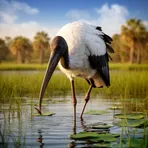
A large stork with a long curved bill that wades in warm American wetlands

A large wading bird like a stork with a long bill that curves downward and lives in American swamps
Surface Forms
Morphology
The compound combines 'wood' (a wooded tract) with 'ibis' (a wading bird) to denote an ibis associated with wooded habitats; a learner who knows both words can infer it is a type of ibis found in woods or wooded swamps. This is a straightforward compositional noun+modifier pattern common across languages, so the meaning is directly derivable from the parts.
Etymology
Wood ibis comes from the bird's habit of wading in swampy woods. People put wood before ibis to show it lives in wooded swamps, so the name means a large wading bird found near trees.