

wild cotton
- noun
- /waɪld ˈkɑtən/
- US
- Botanists studied the fibers produced by wild cotton to compare them with cultivated varieties.
Examples
-
The seeds of wild cotton are an important food source for some desert animals.
-
The wild cotton plant thrives in arid conditions.
-
Wild cotton can be found growing along riverbanks in southern Arizona.
-
Many farmers are interested in wild cottons for their hardiness.
-
The wild cotton plant thrives in the arid regions of southern Arizona.
-
Farmers in Mexico often harvest wild cotton from the nearby bushes.
-
The garden featured beautiful wild cotton, showcasing its characteristic fluffy fibers.
Synonyms
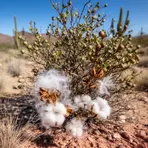
A shrub that grows in southern Arizona and Mexico and has seed pods with soft fibers like cotton

A small cotton bush with hairy leaves from Arizona and Mexico
Surface Forms
Morphology
The meaning 'a cotton plant that grows in the wild / not cultivated' is directly and compositionally derived from combining 'wild' (living naturally, not tamed) with 'cotton' (the plant/crop). This simple modifier+noun pattern is cross-linguistically common and follows standard English semantics, so a B1 learner who knows both constituents would readily infer the MWE meaning.
Etymology
Wild cotton began as a simple picture: wild (not grown on farms) and cotton (the fluffy fiber) that grows naturally on shrubs. So, when people saw white, cotton-like balls on desert or riverbank plants they called those plants wild cotton, and the name still means that untended cotton-producing shrub today.

