
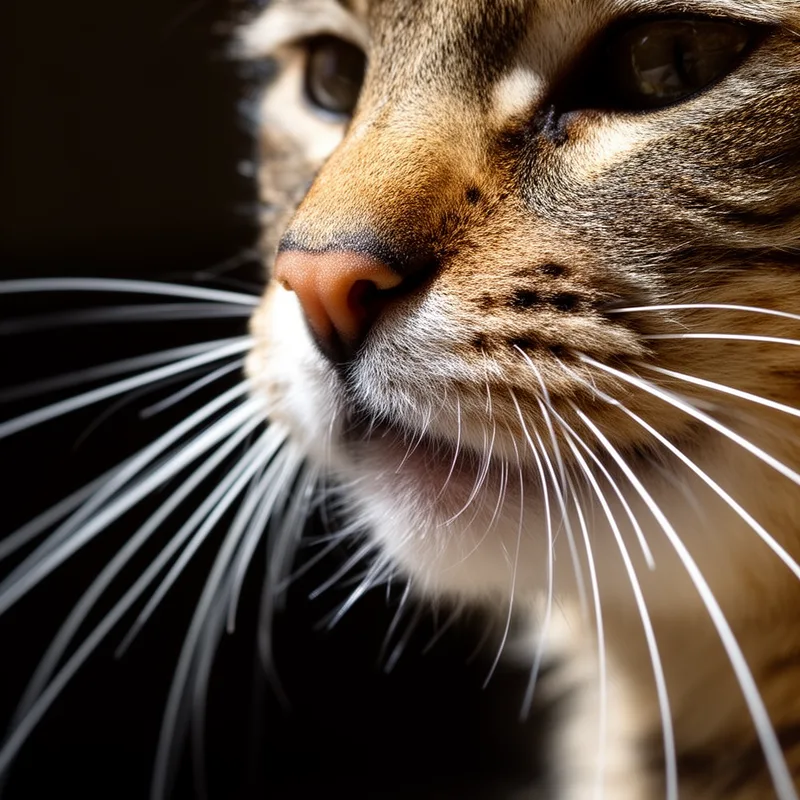
whisker
 37
1.9
37
1.9

- noun
- /ˈwɪskər/
- My dog has a few gray whiskers around his snout, showing his age.
- long whiskers
Loading YouTube…
Watch on YouTubeYeah, that that's clearly cat, though There's whiskers and ears.
- Yeah, that that's clearly cat, though There's whiskers and ears.
- I love the koi fish design, love these little whiskers here.
- And that sense, that hydrodynamic sense is made possible by those incredible whiskers on his face.
- So let's start with the anatomy of a whisker.
- And it had, it must have been eating termites from a deadlock because it had stuff all around whiskers, you know.
Examples
-
And that sense, that hydrodynamic sense is made possible by those incredible whiskers on his face.
-
Tobias rubbed his whiskers and squinted sharply from the sun and from thinking hard.
Fiction book (1994) -
I have a huge black whisker right on my chin.
-
Lions are born with a pattern of whisker spots that never changes; these spots mark each one in a population.
Academic text (2009) -
It's got the little paws and the whiskers.
-
We know that if a cat is got just nice relaxed whiskers out here to the side, that's just a nice relaxed cat.
-
Nothing, Nippy's whiskers are tickling me.
-
The innkeeper was half-buried in the petticoats he carried, his bristling whiskers barely visible over the foamy layers.
Fiction book (1991) -
The cat's long, sensitive whiskers help it navigate through narrow spaces.
-
Mice use their whiskers to sense their surroundings in the dark.
Synonyms

A long stiff hair near an animal's nose that senses touch and air movement
A long stiff hair near an animal's nose or eyes that senses nearby movement
Compounds

How Long

Surface Forms
Morphology
Etymology
Whisker comes from the old word whisk, which meant 'to move quickly' or 'to sweep'. These long face hairs often twitch or 'sweep' the air and help animals feel their way.