

to whisk off
- phrasal verb
- /wɪsk ɔf/
- After the meal, he whisked off the leftovers from his plate with a napkin.
Examples
-
She whisked the snowflakes off her shoulder with a pair of mittens and greeted the men.
Fiction book (1994) -
She hurriedly whisked off the crumbs from the countertop before the guests arrived.
-
After you've done that contouring, just going to whisk off the light powder from the forehead and the chin.
-
She whisked off her pointy blue glasses and waved a plump white arm.
Fiction book (2002) -
Use a clean cloth to whisk off any dust from the table.
Synonyms

 242
1.0
242
1.0

To move a brush across something to clean or paint it
 41
3.4
41
3.4
To move someone or something quickly and lightly
 28
2.0
28
2.0
To remove something from a surface by moving a cloth over it, like tears or dirt
 20
1.0
20
1.0
Remove dirt or marks from a surface by rubbing with a cloth
 8
1.8
8
1.8
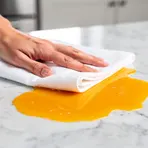
To clean a surface using a cloth or towel to remove a spill

To clean dust and dirt from something using quick movements
Antonyms

How Quickly

Surface Forms
Morphology
The sense 'to take someone or something away quickly and suddenly' is directly derivable from combining 'whisk' (to brush or sweep away quickly) with 'off' (indicating removal or away). This verb+particle composition expresses a clear motion/transfer meaning common in English and other languages, so a B1 learner who knows both constituents should be able to infer the MWE meaning.
Etymology
Whisk off comes from the idea of a quick, light sweep by a hand or a small brush — a whisk moving something off — so it means 'to brush or wipe something off quickly'.