

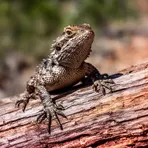
western fence lizard
- noun
- /ˈwɛstərn fɛns ˈlɪzərd/
- Specialized
- The western fence lizard is sometimes called the 'blue-belly' due to its colorful markings.
Examples
-
The western fence lizard basked on the warm rock.
-
We spotted a western fence lizard basking on the sunlit rock during our hike.
-
Several western fence lizards darted away as we approached the old log pile.
-
Have you ever seen a western fence lizard in the wild?
-
The western fence lizard can often be spotted basking on a sunlit rock.
-
In the spring, many people enjoy watching the western fence lizard dart between logs.
-
With its rough, spiny scales, the western fence lizard is well adapted to its desert habitat.
Synonyms
 79
9.8
79
9.8

A small western North American lizard often found on logs or rocks

A common lizard in western North America that sits in the sun on rocks and logs

A small lizard with a blue belly often seen on rocks

A small animal with scaly skin and a long tail that sits on fences or rocks in the US

A group of spiny lizards from North and Central America with rough scales
Surface Forms
Morphology
The compound is compositionally built from 'western' (from the west) + 'fence' (associated with fences) + 'lizard' (a reptile), so a learner who knows the constituents can infer it denotes a lizard from western regions that is commonly found on/near fences or similar perches. This is a literal, habitat/region-based species name rather than an idiom, so the meaning is directly predictable from the parts.
Etymology
Western fence lizard is a name that shows where and how you find the animal: western for the western part of North America, and fence because these small lizards are often seen on fences, logs, or rocks in the sun. That's why the name fits this common animal with rough, spiny scales sometimes called 'blue-belly'.