
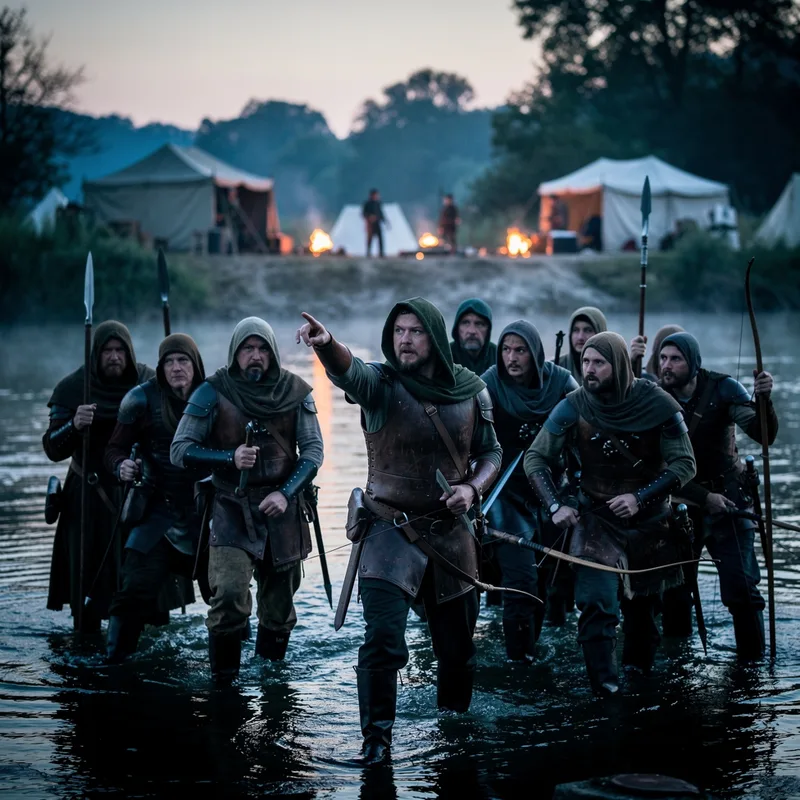
war party
 2
8.8
2
8.8

- noun
- Archaic
- The cabin was attacked by a war party.
- Creek war party
- for instance, a war party
- small war party
Examples
-
With its loss, Seminole and Creek war parties were free to move from the south.
Academic text (2014) -
When a war party defeated the enemy, it came back wearing the red sides outward.
-
Generally, however, war parties were small and swift, and they attacked by surprise.
Academic text (2014) -
He went on a war party against the Pawnees.
-
War parties fell on isolated plantations where Georgians had little warning and no hope of assistance.
Academic text (2014) -
The attack on Fort McIntosh illustrated the highly coordinated and effective movements of Creek and Seminole war parties.
Academic text (2014) -
In the late summer of 1777, for instance, a war party surprised a militia unit there commanded by Captain Dooley.
Academic text (2014) -
The next week, the chief led a war party against another tribe.
-
The attack on Fort McIntosh illustrated the highly coordinated and effective movements of Creek and Seminole war parties.
Synonyms
 98
3.2
98
3.2
A group of soldiers organized to fight or carry out military tasks
 7
4.9
7
4.9
A group of people from a ship who go ashore to do a task
 2
4.7
2
4.7
A military unit made of several groups of soldiers formed to fight
Antonyms
 12
2.8
12
2.8
A public meeting where people gather to show support or opposition without violence
How Large

Surface Forms
Morphology
The meaning is directly compositional: 'war' specifies the type of 'party' as an armed or military group, so a learner who knows both words can infer a group assembled for fighting or raids. This noun-noun combination follows regular English compounding patterns and has close parallels in other languages, making it immediately comprehensible to a B1 learner.
Etymology
War party may come from the literal image of a small group of warriors who set out together to attack an enemy. Thinking of a band leaving at dawn—this war party—helps explain why it means 'a group that goes on a raid or attack' today.