to voice

to voice

137 3.2
To say something aloud, especially an opinion or feeling
  • verb
  • /vɔɪs/
: expresar
  • She decided to voice her concerns during the community meeting about the new development project.
  • voiced a concern
  • voiced an opinion
  • voiced opposition

So if something happens, you voice exactly what that is.

Autoplay Next

Examples

  • Similar discontents were voiced even earlier by Virgil Thomson, a master of music criticism.

    Academic text (1999)
  • Meetings build the confidence to make a statement or voice an opinion while still feeling safe.

    Academic text (2011)
  • And, you know, I get to voice that thing.

  • So if something happens, you voice exactly what that is.

  • Did she ever voice any concern?

  • It's a space where citizens can voice their discontent and show their power.

  • Because even in moments when I tried to voice myself, I, I was shushed.

  • I'm just voicing my concern.

  • No one in the academy ought to have to fear voicing controversial or unpopular views.

    Academic text (1990)
  • The anxiety was palpable when they arrived this morning as the skating community continued to voice its outrage.

Synonyms

to speak
vsto voice
∞ 1.0

To talk with someone to share thoughts or feelings

is specifically about stating something aloud, often as a single expressed opinion
to shout
vsto voice
690 1.0

To speak very loudly to get attention or show strong feeling

is about stating something aloud, often publicly, not specifically loud or attention seeking
to speak out
vsto voice
296 3.4

To say your opinion or feelings openly even when it is difficult

is to state something aloud, but not necessarily with courage or difficulty
to make a statement
vsto voice
180 3.8

To show an opinion in public by what you wear or do

is the general act of stating something aloud, not always meant to attract attention
to utter
vsto voice
105 2.9

To say something aloud

is to express an opinion or feeling aloud, usually with public intent
to vent
vsto voice
67 4.1

To show strong feelings, especially when angry

is stating something aloud, but not necessarily with strong anger or upset
to express feelings
vsto voice
62 3.4

Show or say your emotions to other people

is about stating something aloud, especially publicly, not all ways of showing emotions
to give voice
vsto voice
32 4.3

To put thoughts or feelings into words

is about saying things aloud, often publicly rather than just wording them
to voice opinion
vsto voice
26 3.2

To say your thoughts or views aloud in public

is the broader action of stating something aloud, not limited to views
to voice concern
vsto voice
  • Formal
21 3.9

Speak in public to say you are worried about something

is the general act of stating something aloud, not limited to worries
to express emotion
vsto voice
18 3.4

Show your feelings with words, actions, or your face

is focused on saying or stating things aloud, not on facial or other expression
to vocalize
vsto voice
14 4.4

To use your voice to show your thoughts or feelings

is focused on stating opinions or feelings aloud, not general sound production
to speak openly
vsto voice
13 3.4

Talk honestly without hiding facts or feelings

is saying something aloud, not necessarily stressing honesty or candor
to verbalize
vsto voice
  • US
10 4.8

To put thoughts or feelings into words

is about stating something aloud often publicly, not just forming words privately
to ventilate
vsto voice
  • Formal
2 5.3

Express strong feelings or complaints openly

is the general act of stating things aloud, not only complaints
to speak one's mind
vsto voice
  • Informal
1 3.5

Say what you think openly

is to express something aloud, but not always with frankness
to vociferate
vsto voice
  • Formal
1 9.9

Shout loudly with strong feeling, often to protest

is to express or state something aloud, usually without the loud shouting or protest
to use one's words
vsto voice
  • Informal
1 4.1

To say how you feel or what you need instead of using actions

is the general act of saying something aloud, not only replacing nonverbal behavior

Antonyms

373 2.0

A period with no sound or speech

151 4.8

To stop public protest by force or by people in power

Idioms

A group of people all agree and speak or act together

To discover and show your own style when you speak or create

4 8.8

A person whose warnings or ideas are ignored by others

Speak up for people who cannot be heard

To enjoy hearing yourself talk because you feel important

1 5.4

Begin to express your own ideas clearly and confidently

As loudly as possible so people can hear

To enjoy hearing yourself speak while not listening to others

Phrasal Verbs

Speak quietly so you do not disturb others

32 4.3

To put thoughts or feelings into words

To say your thoughts or views aloud in public

21 3.9

Speak in public to say you are worried about something

1 6.3

To express a complaint or concern, often publicly

Speak more loudly, often because you are angry or want to be heard

9.2

To complain about something in a casual way

Compounds

720 3.6

A spoken narration in a film or TV show by someone not seen on screen

87 3.2

A phone service that lets people leave messages and hear them later when no one answers

40 3.1

The way someone speaks that shows their feelings or mood

17 3.7

A group showing agreement by all saying the same thing

16 3.1

The sound a person makes when making musical notes with their voice

12 3.7

A part in the throat that makes sounds when you speak

voice command
  • Specialized
6 3.7

A spoken instruction you give to a device to make it do something

passive voice
  • Specialized
4 4.8

A sentence form where the subject receives the action, usually formed with 'be' plus a past verb form like 'eaten'

What most people think or want about a public issue

A male singing sound lower than tenor but higher than bass

Talking to share information, often by phone or radio

bass voice
  • Specialized
2 3.1

A low male singing voice that sounds deep and rich

tenor voice
  • Specialized
2 4.3

A high adult male singing voice often used for solo parts

An inner feeling that tells you if something is right or wrong

active voice
  • Specialized
1 3.7

A sentence where the subject does the action

head voice
  • Specialized
1 7.1

A high singing sound that feels like it vibrates in the head

voice for radio
  • Literature
1 4.5

A pleasant clear way of speaking that sounds good on the radio

chest voice
  • Specialized
1 5.5

The lower part of the singing voice that sounds full and is felt in the chest
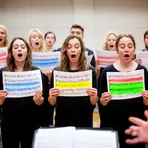
voice part
  • Specialized
1 3.4

A part of a song for singers who sing in the same range, for example soprano

1 6.3

An inner feeling that quietly tells you right from wrong

1 6.7

A voice that sounds too sweet and not sincere

middle voice
  • Specialized
1 9.1

A verb form where the subject does an action to itself or for itself

voice for print
  • Literature
1 6.8

A clear, polished way of writing for newspapers or magazines

A quiet inner feeling that tells you when something is wrong

How Forceful

to declare
  • Formal
937 3.7
to state
225 1.6
to voice
137 3.2
to say
∞ 1.0
to mention
∞ 1.0
to hint
119 2.0

Surface Forms

voice infinitive
voiced past
voiced past participle
voicing present participle
voices third person singular

Etymology

Voice comes from the Latin vox, 'voice', and as a verb it means to give something a voice. To 'voice' an opinion is to say it aloud so others can hear.