
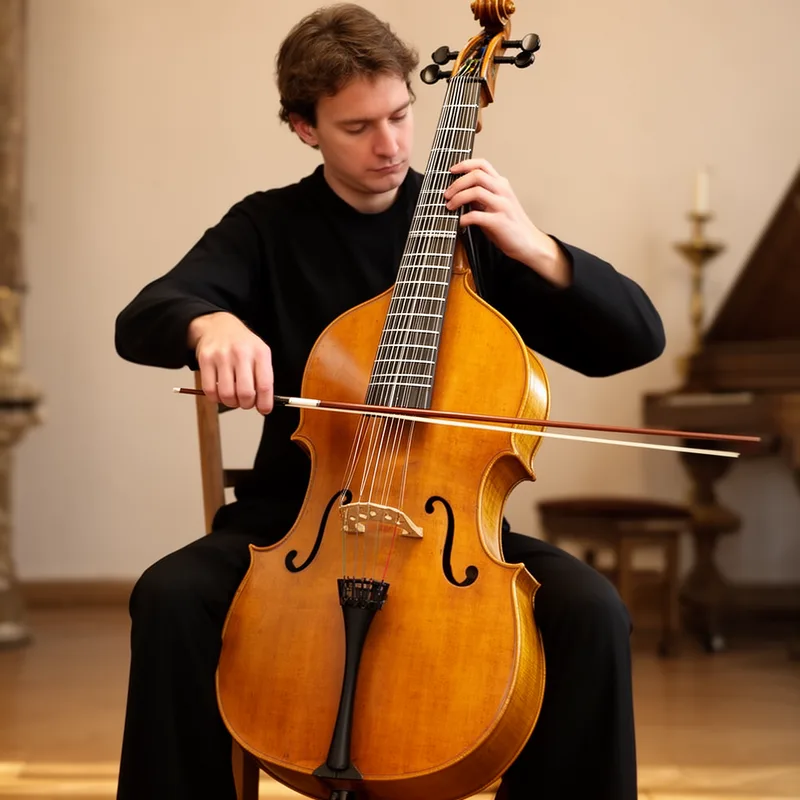
viola da gamba
- noun
- /viˈoʊlə də ˈɡæmbə/
- Archaic
- Many composers wrote for the viola da gamba during the Baroque period.
Examples
-
He learned to play the viola da gamba after studying the cello.
-
A collection of violas da gamba was displayed at the music museum.
-
The viola da gamba was a popular instrument in Baroque chamber music.
-
The viola da gamba has a rich, warm tone.
-
The orchestra included a viola da gamba alongside the violins and cellos for a richer sound.
-
During the concert, the soothing tones of the viola da gamba captivated the audience.
-
She played the viola da gamba beautifully, showcasing its unique voice and historical significance.
Synonyms
A low pitched string instrument that you play with a bow like a cello
A large old string instrument with a deep, rich sound like a big cello
How Low

Surface Forms
Morphology
The phrase is compositionally built (literally ‘viola’ + Italian preposition ‘da’ + ‘gamba’), so a learner who knows the parts can infer it denotes a type of string instrument related to the gamba. However, 'da' is a non‑English function word and the term is a specialized historical name (a specific bass viol), so the exact referent and register are not fully predictable from the parts alone.
Etymology
Viola da gamba comes from Italian: viola is the instrument name and da gamba means 'of the leg' because players held the instrument between their legs when they played. That's why the name refers to the low, cello-like viol used in old chamber music.

